
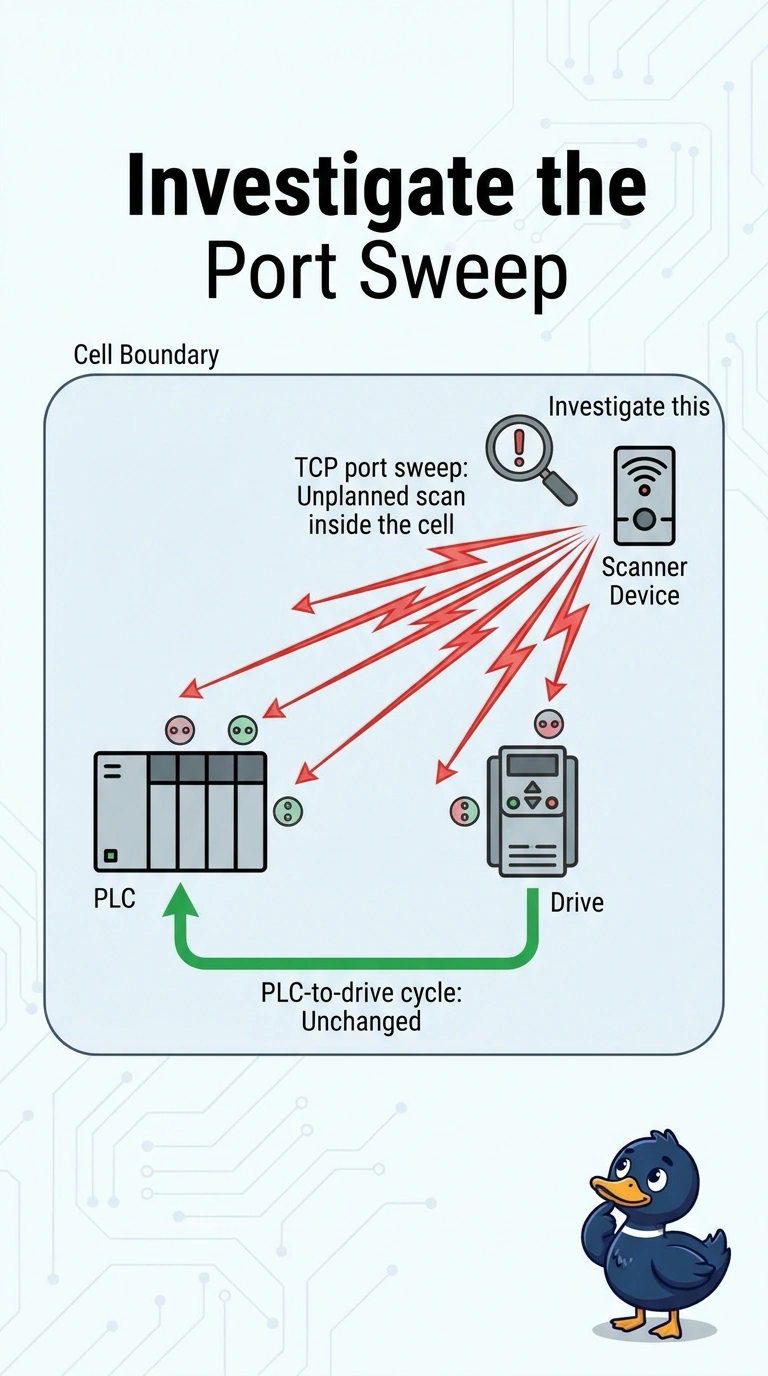
During a normal production hour on a paint line, one host sweeps TCP ports across the cell while the PLC-to-drive cycle looks unchanged. Which issue deserves investigation?
Select an answer to reveal the explanation.
Short Explanation
A port sweep is someone trying every doorknob while the paint line is running. You investigate that scan, not the steady cycle between the PLC and its drive. A poll that has looked the same for months is ordinary process traffic.
Full Explanation
The paint line's normal picture is the steady cycle between the PLC and its drive, plus the polls that have been in the baseline for months. A host sweeping TCP ports across the cell during a production hour is an active scan. A process exchange does not walk a long list of ports, so that sweep is the activity to investigate. Calling the steady PLC-to-drive cycle the anomaly inverts the baseline. That cycle is the process itself. The local HMI poll that repeats every second is a regular supervisory read. A long run of the same poll is evidence that it is ordinary, not evidence that it is an attack. A historian tag read already in the accepted baseline is the same kind of known flow. Membership in the baseline is what keeps it off the anomaly list. Walking many ports is a different shape from one known poll that the baseline already expects. Exam caveat: a scan that operations booked inside a maintenance window can be legitimate work. This stem is a normal production hour with no such window, so the sweep is unplanned. Operational check: identify the sweeping host and its switch port, confirm no change ticket covers the scan, and remove the host if nobody owns the activity.