
An OT inventory lists IP addresses, vendors, and firmware, but not whether a controller is a safety system or basic control. A new finding is about to be prioritized. Which gap matters?
Select an answer to reveal the explanation.
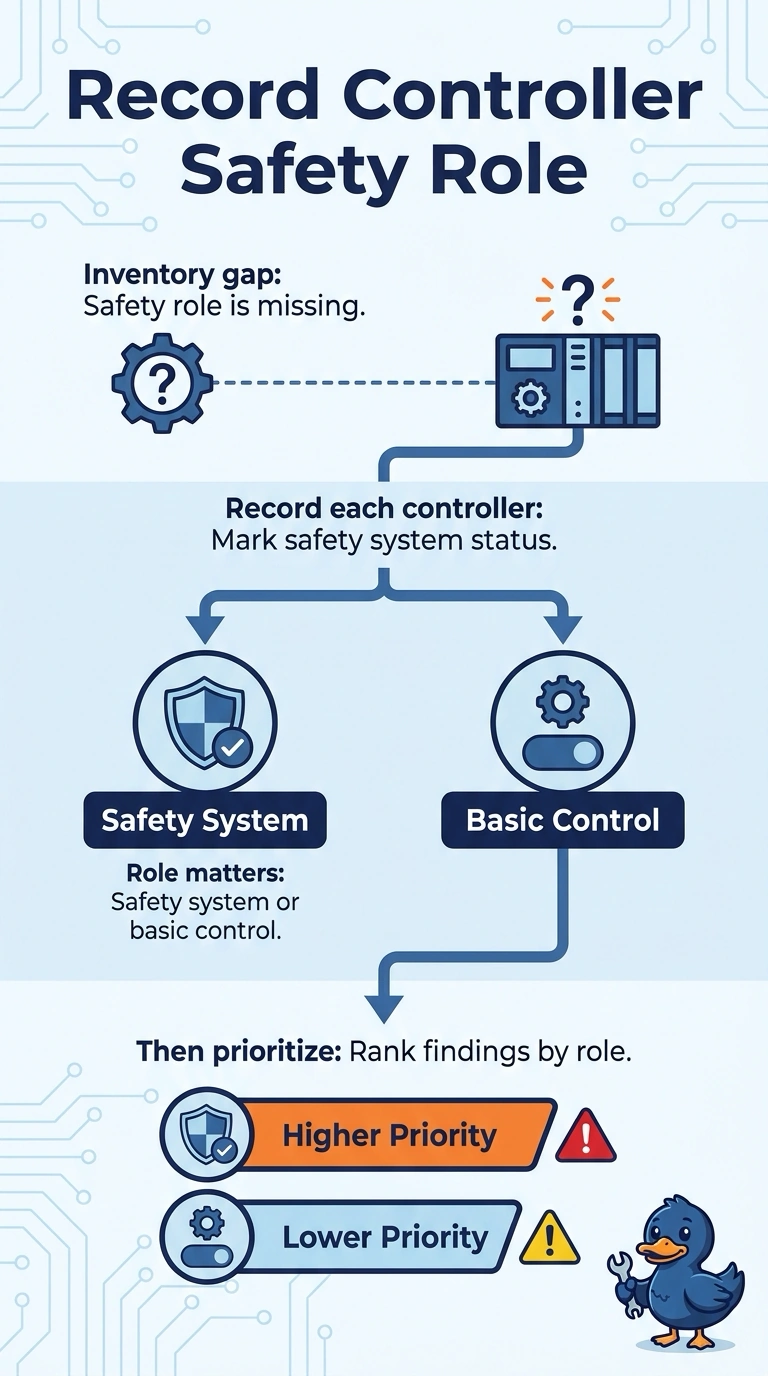
Short Explanation
You can have two controllers with similar network details but very different jobs. Record which controllers are safety systems so you can rank a finding by role. A tidy IP list cannot tell you whether a controller supports a safety function.
Full Explanation
Prioritization uses a controller’s role as well as its exposure. Recording whether each controller is a safety system gives you the information needed to rank a finding appropriately; a safety controller and a basic-control PLC are not interchangeable. An inventory that omits this distinction forces you to guess when a bulletin arrives. Vendor and firmware fields remain useful for matching the bulletin, but they do not replace role information, and an IP address alone cannot show whether a trip function is present. Treating an IP address as the only field needed before production resumes therefore leaves a meaningful gap. Deleting the firmware field would remove useful matching information without establishing the controller’s role. Marking every controller as safety would erase the distinction needed for prioritization rather than resolve the gap. The safety designation should come from process documentation, not from a guess based on the subnet. As a practical check, confirm that a known safety PLC is identified as safety in the inventory and that a neighboring basic-control controller is not. This verifies that the inventory distinguishes controller roles while retaining the vendor and firmware details useful for matching findings.