
Cisco Cyber Vision reports a new activity on a container-port crane PLC: The local engineering station completed a program download to the crane PLC, and comparison with the approved project confirms that different controller logic was loaded. No change ticket exists. Which reading fits?
Select an answer to reveal the explanation.
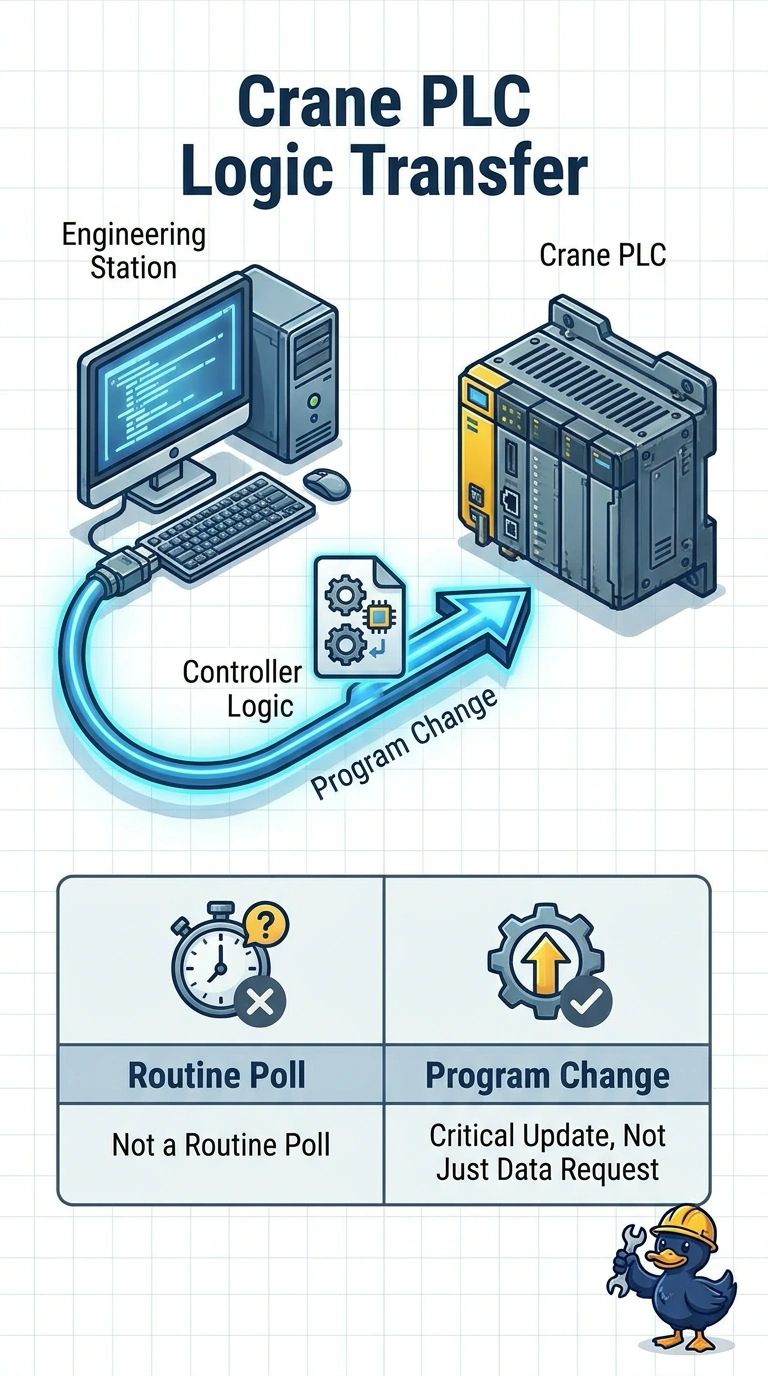
Short Explanation
A routine poll is a glance at the gauges, while a logic transfer is someone opening the panel and rewriting the machine. You treat that Cyber Vision activity as a program change until a ticket says otherwise. A clock update or a file backup does not load controller logic.
Full Explanation
Cisco Cyber Vision builds activities from the industrial traffic it decodes. A transfer of controller logic from the engineering station to the crane PLC is a program change, different from status polling that same station may exchange on an ordinary shift. With no change ticket, the sound reading is that this host loaded logic onto the crane, and the people who run the cranes should confirm whether anyone asked for that load. A clock renewal is a time message, not a logic transfer. A decoder that has already identified a program download is not guessing from a time protocol. Copying a user profile to a file server is a file operation on the station or the server, and it does not write the controller program. GOOSE is a Layer 2 protection message used between substation devices. Retransmissions in another yard do not explain an engineering download to a port crane PLC. Exam caveat: the transfer can still be legitimate maintenance that nobody ticketed. Start from the industrial action that was decoded, then confirm authorization, and do not recast a decoded logic transfer as a harmless poll. Operational check: match the station, the crane PLC, and the transfer time to the port change log, and disconnect the station if nobody owns the load.