
An oil-well pump drive has a known weakness, and the OEM image cannot be loaded until a scheduled outage. A colleague says to virtual-patch it by installing firmware now. Which compensating approach fits?
Select an answer to reveal the explanation.
Short Explanation
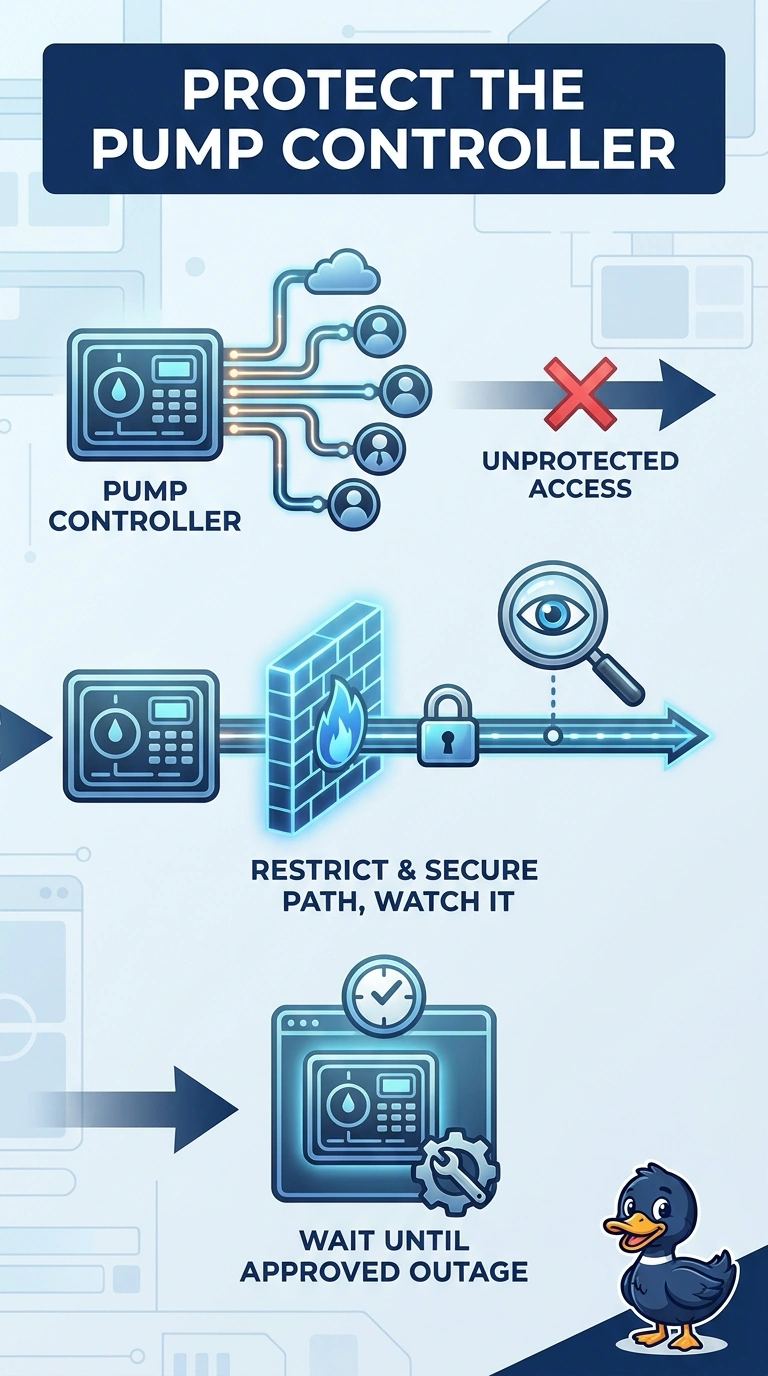
When you cannot rebuild a bridge today, you narrow the road and you post a watch. You restrict the well-pump drive so only its controller can reach it until the approved image goes in at the outage. A personal USB stick is not that approved image.
Full Explanation
The OEM image is not approved until the scheduled outage, so loading firmware now is not available. Restricting the network path is a compensating exposure control. A virtual patch additionally blocks the covered exploit, typically through an appropriate IPS or equivalent validated rule; source restriction alone may not stop an attack from the allowed controller. so only the pump controller can reach the drive, and watching that path until the outage. The weakness remains in the drive. Fewer hosts can try to use it, which is the compensating control that fits a well that has to keep pumping. An unsigned image from a personal USB stick is not the OEM image, and loading it during the current run adds an untested process risk instead of waiting for the approved file. Rebooting the drive every hour does not remove a firmware weakness, and it interrupts the well for no remediation. Moving the drive onto the office wireless LAN so a workstation patch job can reach it widens exposure and aims a PC patching tool at a drive that does not take that kind of update. Exam caveat: the path restriction does not clear the weakness. It holds exposure down until the OEM window, and the outage ticket still has to carry the approved image. Operational check: a test host other than the pump controller should fail to reach the drive, and the USB stick should not be part of the outage plan.