
A pharma batch reactor has a firmware bulletin for its safety controller. The vendor procedure requires a planned validation run, and the basic-control PLC is a different device. Which remediation fits?
Select an answer to reveal the explanation.
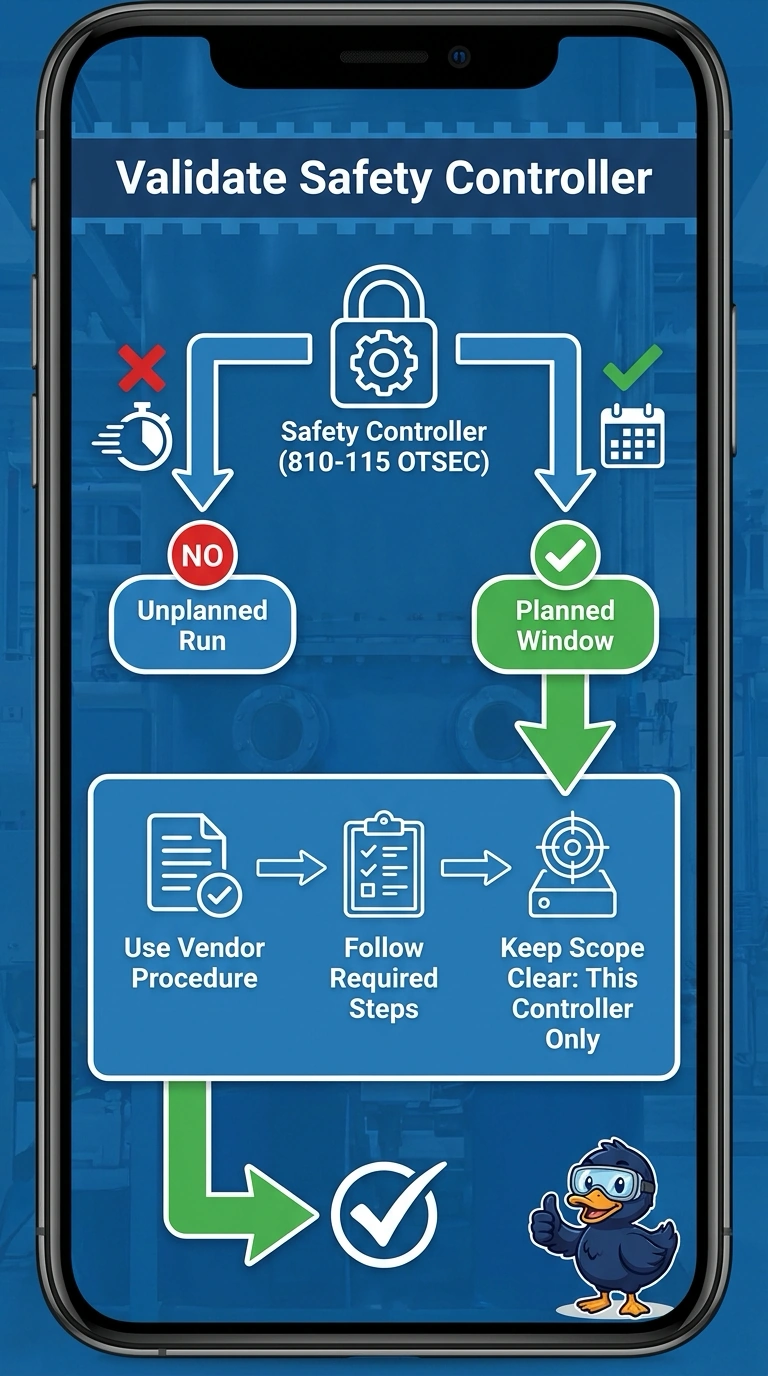
Short Explanation
You protect the reactor by following the vendor procedure for the safety controller in a planned validation window, rather than treating it like an office PC or changing it mid-batch. Its protective role makes careful, validated maintenance especially important. An unsigned USB file is not a substitute for the vendor procedure.
Full Explanation
The fitting remediation is to follow the vendor procedure for the safety controller in a planned validation window, because its firmware is part of the reactor’s safety case and the required validation must be planned. The bulletin is real, but it does not justify changing the controller during the current batch or loading a file the vendor did not issue for that device. The basic-control PLC is a different asset, so its maintenance calendar does not determine how the safety controller is maintained. Installing the site’s usual Windows monthly update mistakes the safety controller for a workstation and could disrupt its protective function mid-batch. Loading an unsigned firmware file from a USB stick is not the vendor-approved image; a newer file is not automatically safe for a reactor. Skipping safety controllers gets the consequence backward: their protective role is a reason to follow applicable vendor procedures carefully, not to ignore a bulletin. Exam caveat: the stem describes a bulletin while the controller is still doing its job; an active unsafe failure would be a different scenario, which the stem does not describe. Practical check: verify that the change ticket names the vendor procedure, validation run, and planned window, and confirm that no file is loaded while the batch is in progress.