
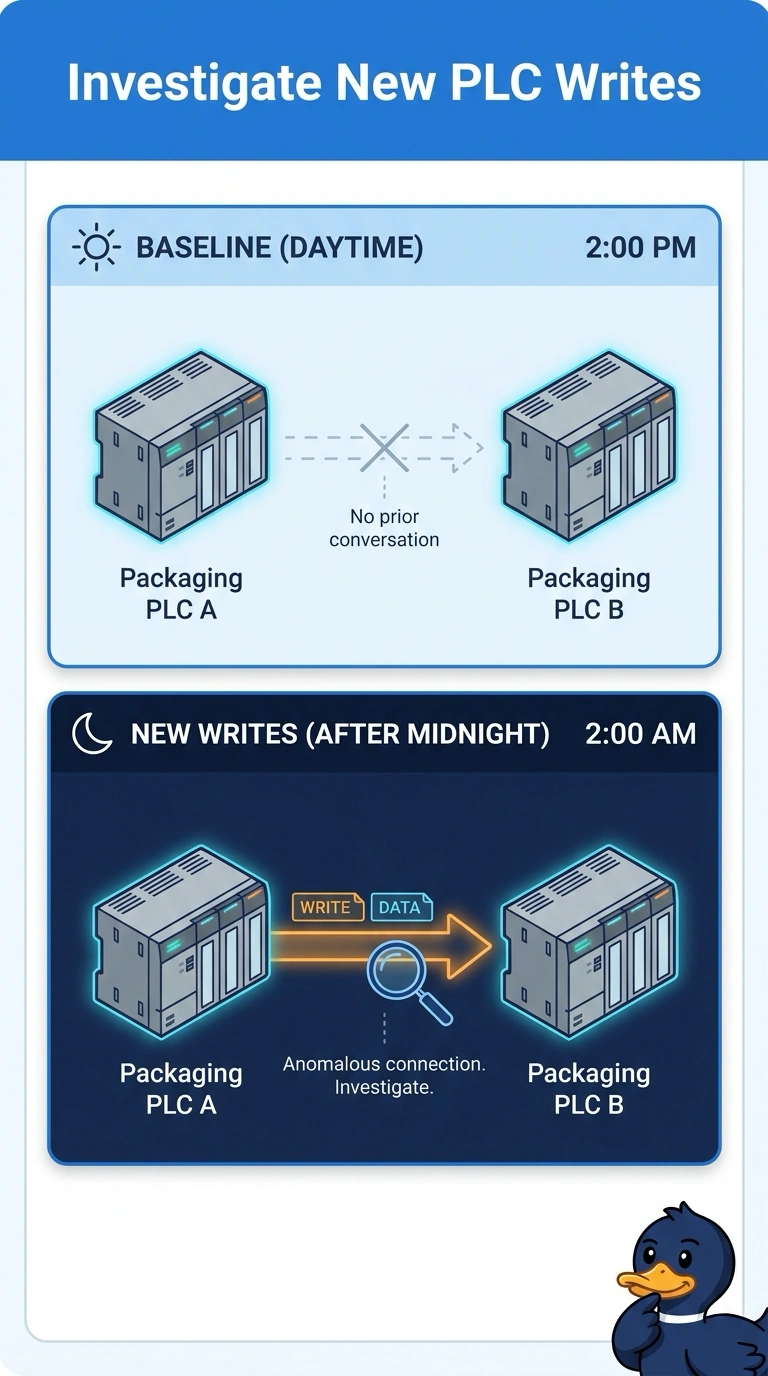
A visibility tool shows two packaging PLCs exchanging writes after midnight. Their baseline has never included a conversation with each other. Which reading fits?
Select an answer to reveal the explanation.
Short Explanation
A new conversation at night is a stranger in the break room, not the usual hum of the line. You investigate the writes between two PLCs that have never been in each other’s baseline. Calling every PLC-to-PLC packet cyclic just because both ends are controllers is the trap.
Full Explanation
A communication baseline is the set of conversations you have already accepted. Writes between PLCs that have never spoken are a behavior change, and midnight is not an exemption. Treating them as normal cyclic traffic just because both devices are PLCs confuses a known exchange with a known peer—usually a controller and its I/O—with a brand-new peer. Deleting the baseline would hide the change instead of explaining it, while ignoring the writes because they began outside the day shift mistakes the shift clock for evidence that the activity is expected. A scheduled maintenance job can be a benign cause, so have the work order in hand before calling the writes hostile. Check the source, destination, and function: who wrote, to which PLC, and whether a work order covers it. Put before-and-after evidence in the work order, including the interface or account changed, the time, and the person who approved it. On the next shift, confirm the original symptom is gone and that the change did not open a second path while closing the first. If the process is still inside a live batch, leave the controller running and finish only the work that does not restart it. This sequence helps keep a correct fix from becoming an unplanned outage.