
Cisco Cyber Vision shows a new I/O module on a hoist PLC that was not in yesterday's component record. No change ticket exists. Which reading fits?
Select an answer to reveal the explanation.
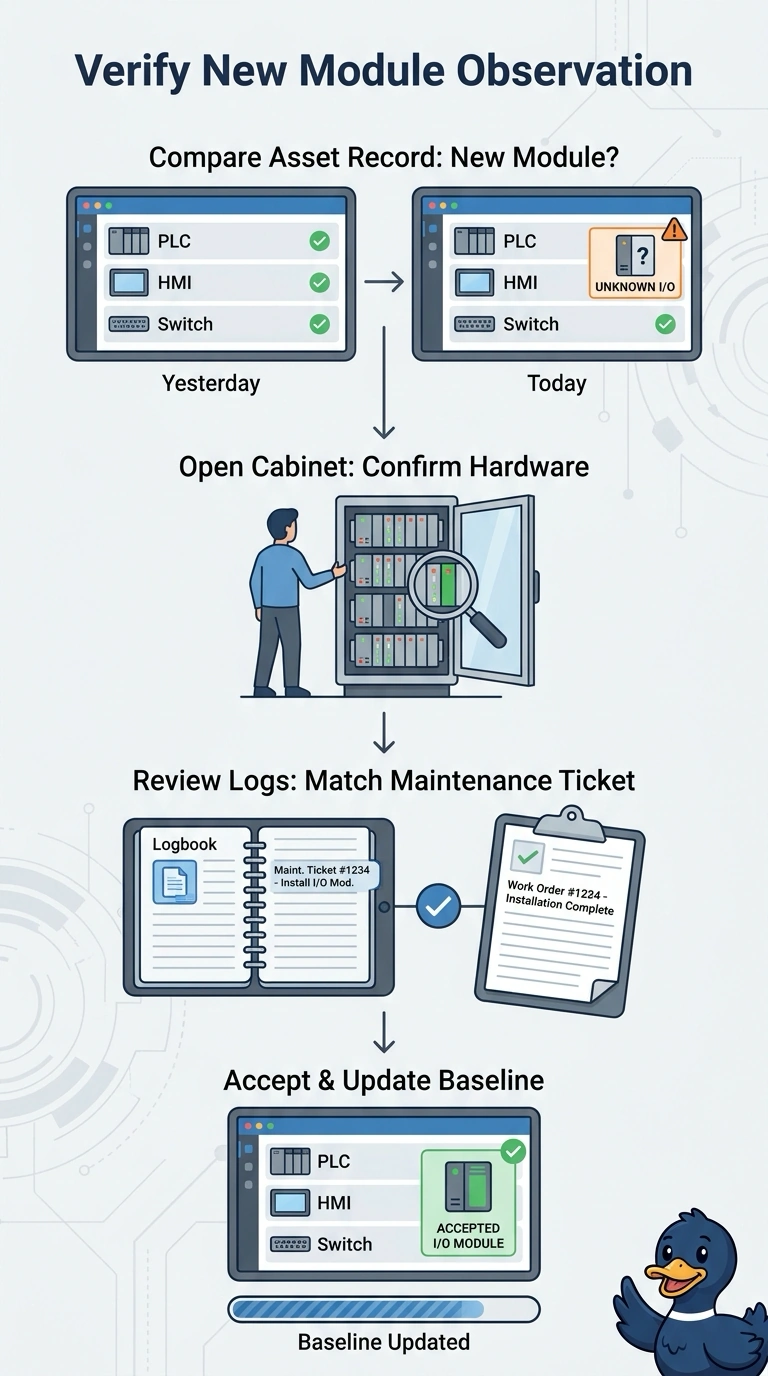
Short Explanation
Yesterday this hoist PLC had one set of cards, and today the sensor sees a card that was not there. You treat that like hardware someone added, until maintenance can show the work. A lost copy of traffic does not invent a module, and a spreadsheet does not install one.
Full Explanation
Cisco Cyber Vision learns the modules it can see on a controller. A new I/O module in the component record, with no ticket, means the observed inventory changed; delayed discovery or added visibility may reveal an existing module without a physical installation. The reading is an unplanned modification until the hoist crew shows a maintenance action that added the card. Clearing the event without opening the cabinet skips that check. A lost traffic copy stops updates. It does not add a module that was not previously observed. The usual hoist cycle is process traffic. A small change in scan time is not how a new I/O module is reported. An enterprise spreadsheet restore puts a file back on a server. It does not write hardware modules into a PLC. Exam caveat: a controller can advertise a module during a planned expansion that simply was not ticketed in the tool. You still match it to a work order before you fold it into the baseline. Operational check: compare the reported module with the cards actually installed in the rack and with the maintenance log, and open an incident if nobody installed it.