
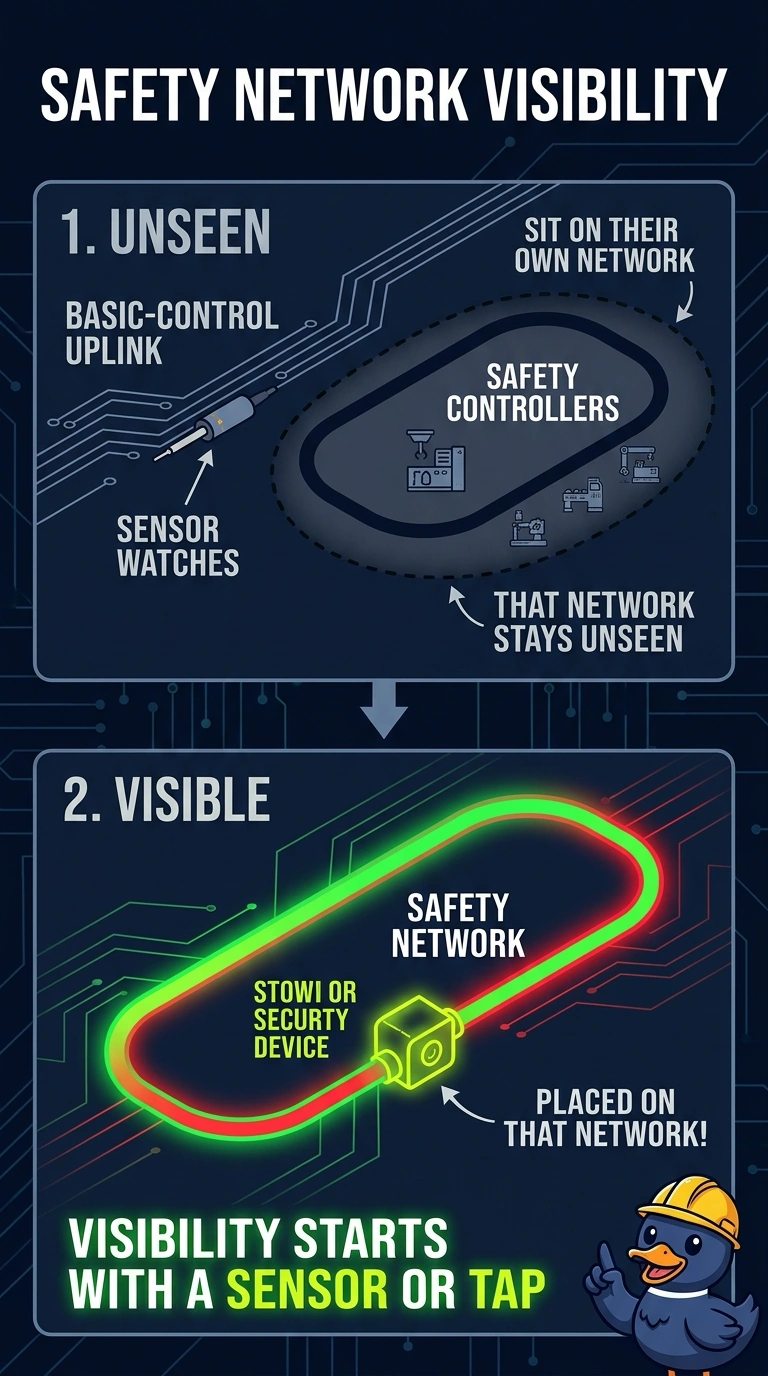
A chemical plant's only visibility sensor watches the basic-control uplink. The safety controllers sit on their own network and never appear. Which gap is that?
Select an answer to reveal the explanation.
Short Explanation
A camera in the front hall never sees a room with its own door. You have to watch the safety network itself, because those controllers do not send their trips across the basic-control uplink. Guessing from traffic that never arrives is how the safety layer stays invisible.
Full Explanation
An OT visibility tool reports only the traffic it is given. Safety controllers on their own network exchange trips and status there. If that network never crosses the basic-control uplink, a sensor on the uplink cannot name those controllers or their conversations. The gap closes when a SPAN session or a tap is placed where the safety traffic actually flows. Inferring trips from an uplink that does not carry them invents an inventory. Windows logs on the basic-control HMIs record what those HMIs do, not the peer-to-peer traffic on a separate safety network. Enterprise firewall denies are boundary events. They are not a map of a network that does not route through that firewall. Exam caveat: some plants deliberately mirror a one-way safety alarm into basic control. That copy is not a substitute for seeing the safety network itself. Operational check: compare the safety drawing with the sensor's asset list and confirm the safety controllers appear only after their own network is tapped. Do that before the next safety test.