
A water-plant PLC cannot take a vendor patch until next year's outage. The conduit currently allows any Modbus function from several hosts. The HMI only needs to read. Which change fits until that outage?
Select an answer to reveal the explanation.
Short Explanation
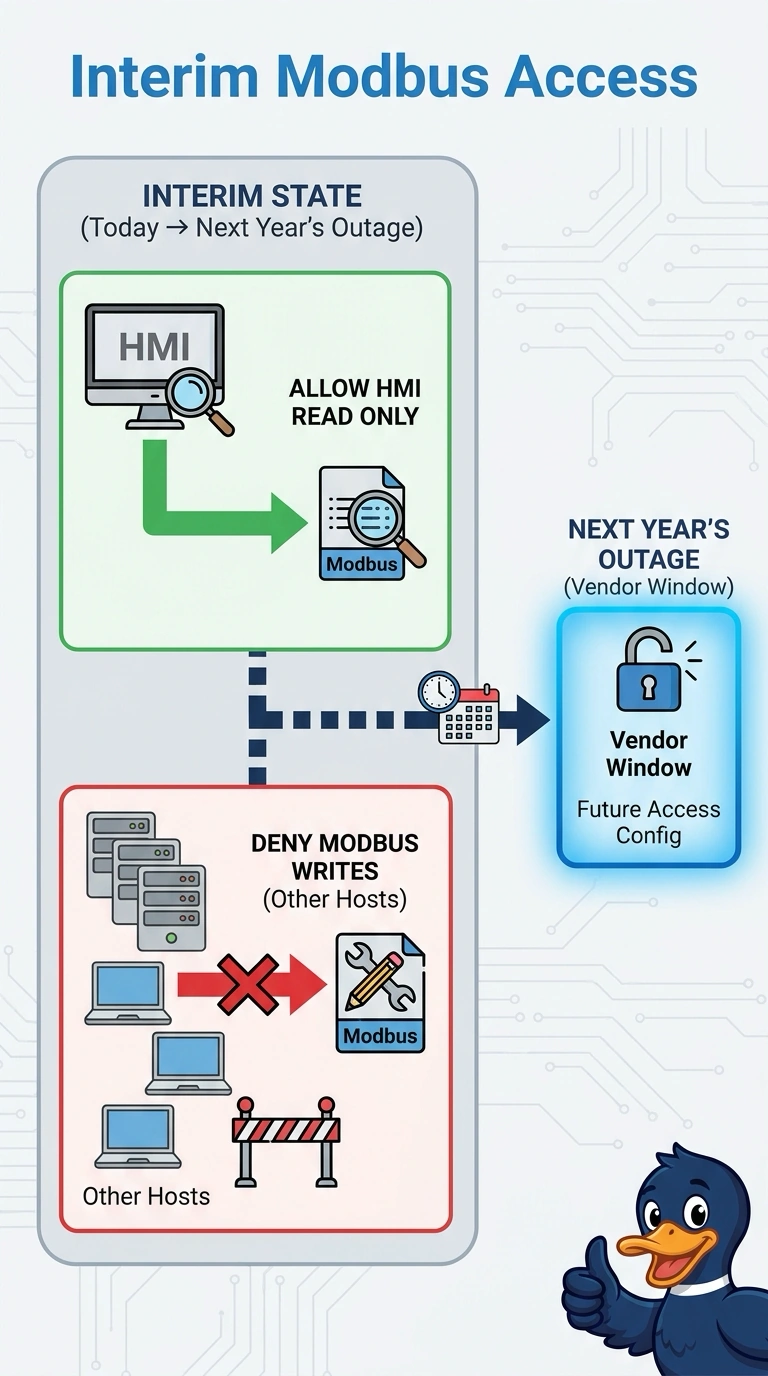
You cannot patch the PLC this year, so you shrink what the network will let people say to it. The HMI may read, and the other hosts lose the ability to write. Opening the conduit wider, or loading a stranger's firmware, is not a substitute for the vendor window.
Full Explanation
When a patch has to wait for a vendor outage, the compensating control is on the path. The HMI's job is a read. The conduit should allow that read from the HMI and deny Modbus writes from the other hosts that currently have a free hand. Use industrial-protocol-aware enforcement that permits only the required Modbus read functions and blocks writes; a conventional IP/TCP ACL permitting port 502 does not distinguish Modbus reads from writes. The PLC stays in service, and the exposure shrinks until the real fix. Permitting every function from the enterprise subnet widens the path in the name of monitoring and gives more hosts the ability to change the process. A forum firmware image is not the vendor patch and does not justify leaving the conduit open. Shutting the PLC down until next year removes the process the plant still has to run. Exam caveat: a read-only rule is only as good as the devices that enforce it. If a second path around the conduit exists, the writes continue. Look for that path. Operational check: from the HMI a read should succeed, from a second host a write should hit the deny, and the change ticket should name next year's outage as the date the compensating rule is revisited.