
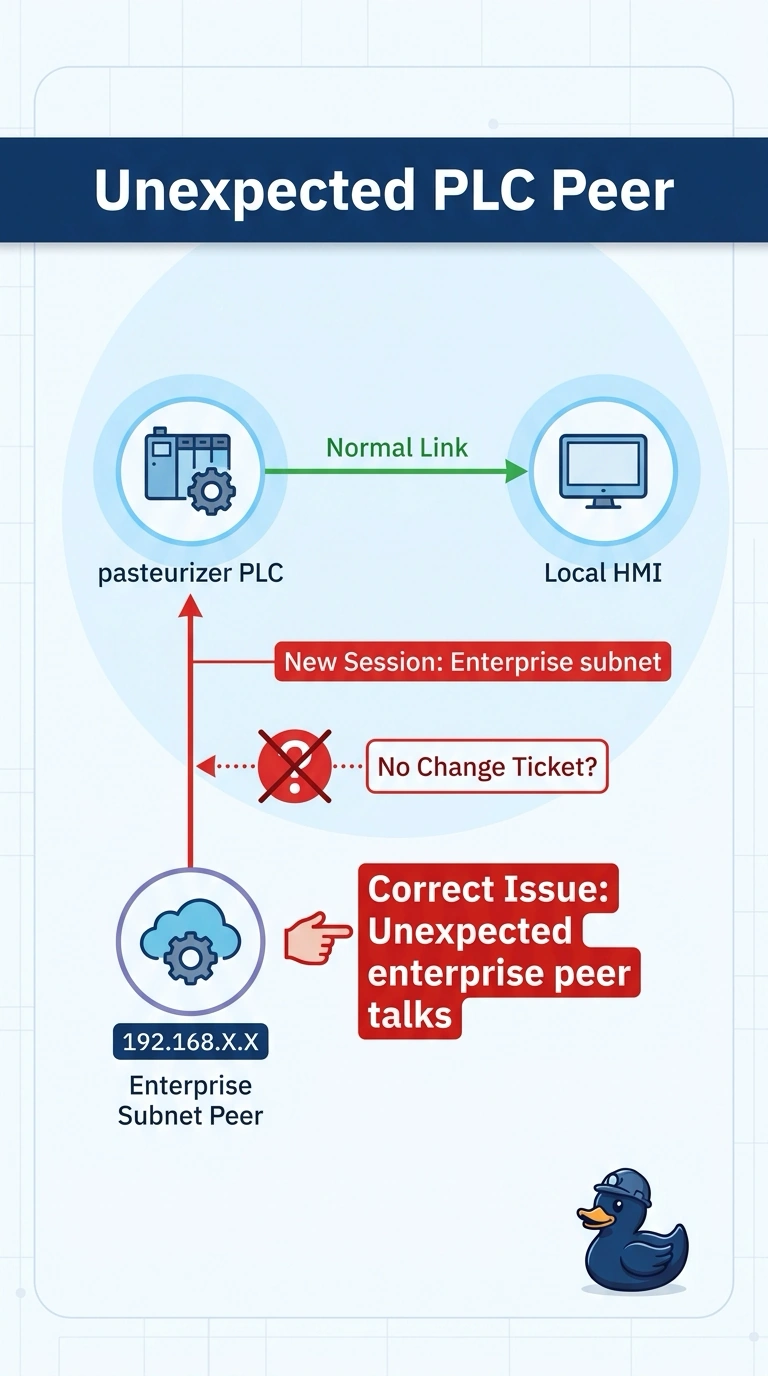
A dairy pasteurizer PLC normally talks only to its local HMI. Visibility now shows sessions with an address on the enterprise subnet, and no change ticket exists. Which issue is that?
Select an answer to reveal the explanation.
Short Explanation
Your baseline shows the pasteurizer PLC talking only to its local HMI, so an enterprise-subnet address is a new peer. You treat that unexpected peer as an anomaly until a ticket explains it. A familiar HMI poll is different, and wireless overlap next door does not explain this session.
Full Explanation
The baseline says this pasteurizer PLC talks only to its local HMI. A session with an enterprise-subnet address is a new peer outside that pattern, and there is no change ticket, so you treat it as an unexpected-peer anomaly until someone confirms the conversation was approved. A normal cycle would involve the known HMI at the known pace. Calling the new address the historian the cell has always used assumes a peer that the baseline does not contain. Firmware loss on the PLC concerns its image; it does not explain why a new enterprise address is talking to the PLC. Visibility here identifies a new peer, not a firmware change. Wireless channel overlap in the neighboring office building could impair a radio link, but it does not create a session between the pasteurizer PLC and an enterprise-subnet address. The report concerns who is talking, not spectrum. Exam caveat: the enterprise address could be a historian that someone forgot to add to the baseline. The finding still means the peer was not expected, so closing it requires a named owner and a ticket. Practical check: identify the enterprise host, confirm whether an approved change allowed it to reach the pasteurizer VLAN, and remove the path if nobody owns the session.