
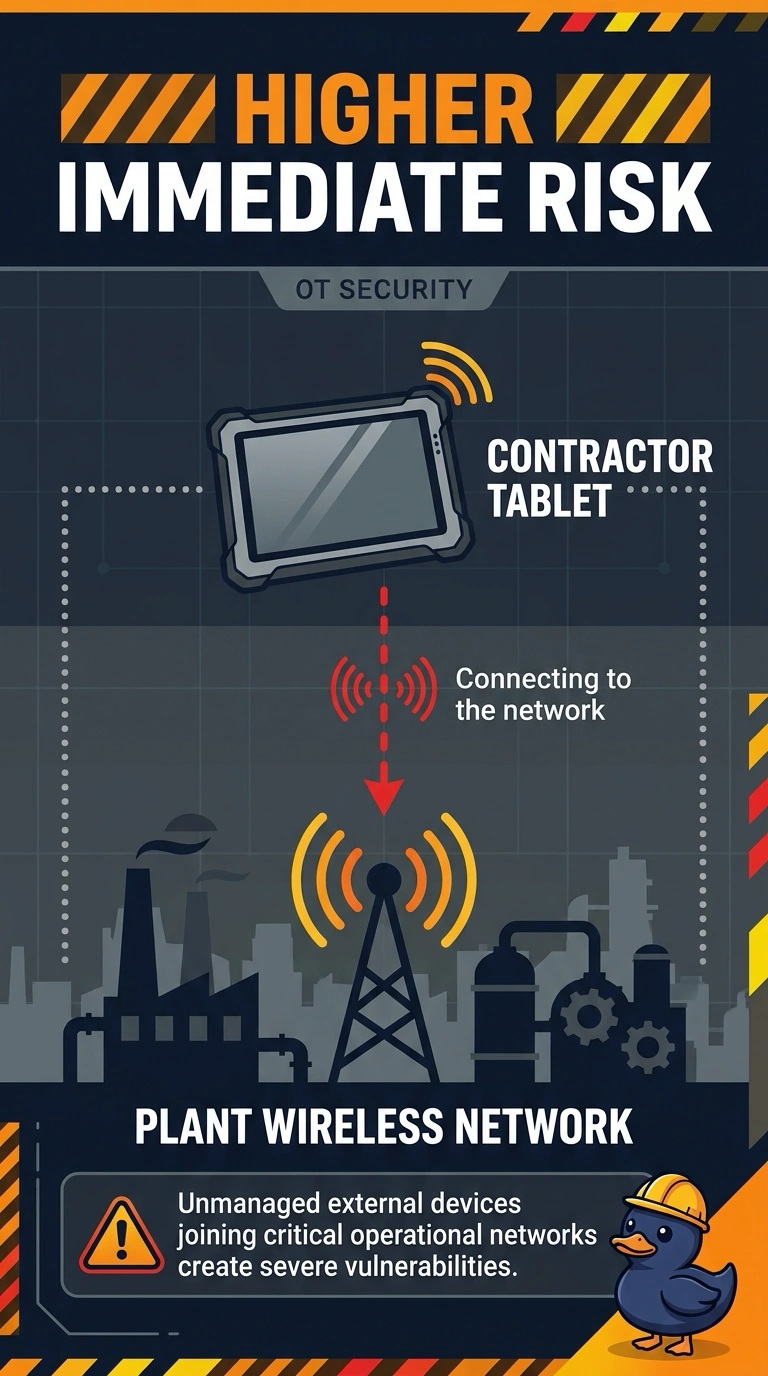
One firmware flaw is on a contractor tablet that joins the plant wireless network. The same flaw is on a spare panel PC that is powered off in a locked cage. Which asset is the higher immediate risk?
Select an answer to reveal the explanation.
Short Explanation
A flaw in a drawer cannot click anything. You rank the tablet that can actually join the plant wireless network. The trap is scoring the sticker and ignoring which device is awake.
Full Explanation
Immediate risk needs a path. The tablet associates to the plant wireless network, so the flaw is on a device that can send traffic now. The spare is powered off in a locked cage, so the same flaw has no session. A locked cage does not put the spare on the process. Matching firmware strings do not make the two exposures equal. Powered-off equipment is not treated as reachable. The caveat is that the spare is still tracked so it is patched before someone installs it on a shift. The check is the wireless client list: the tablet should be the asset with a live association, and it is the one you contain first. Put the before-and-after evidence in the work order, including the interface or account you changed, the time, and the person who approved it. On the next shift, confirm the original symptom is gone and that the change did not open a second path while closing the first. If the process is still inside a live batch, leave the controller running and finish only the part of this work that does not restart it. That sequence keeps a correct fix from turning into an unplanned outage.