
Cisco Cyber Vision associates a known vulnerability with one assembly-cell drive because the drive firmware matches the affected build. No attack traffic is shown. Which reading fits?
Select an answer to reveal the explanation.
Short Explanation
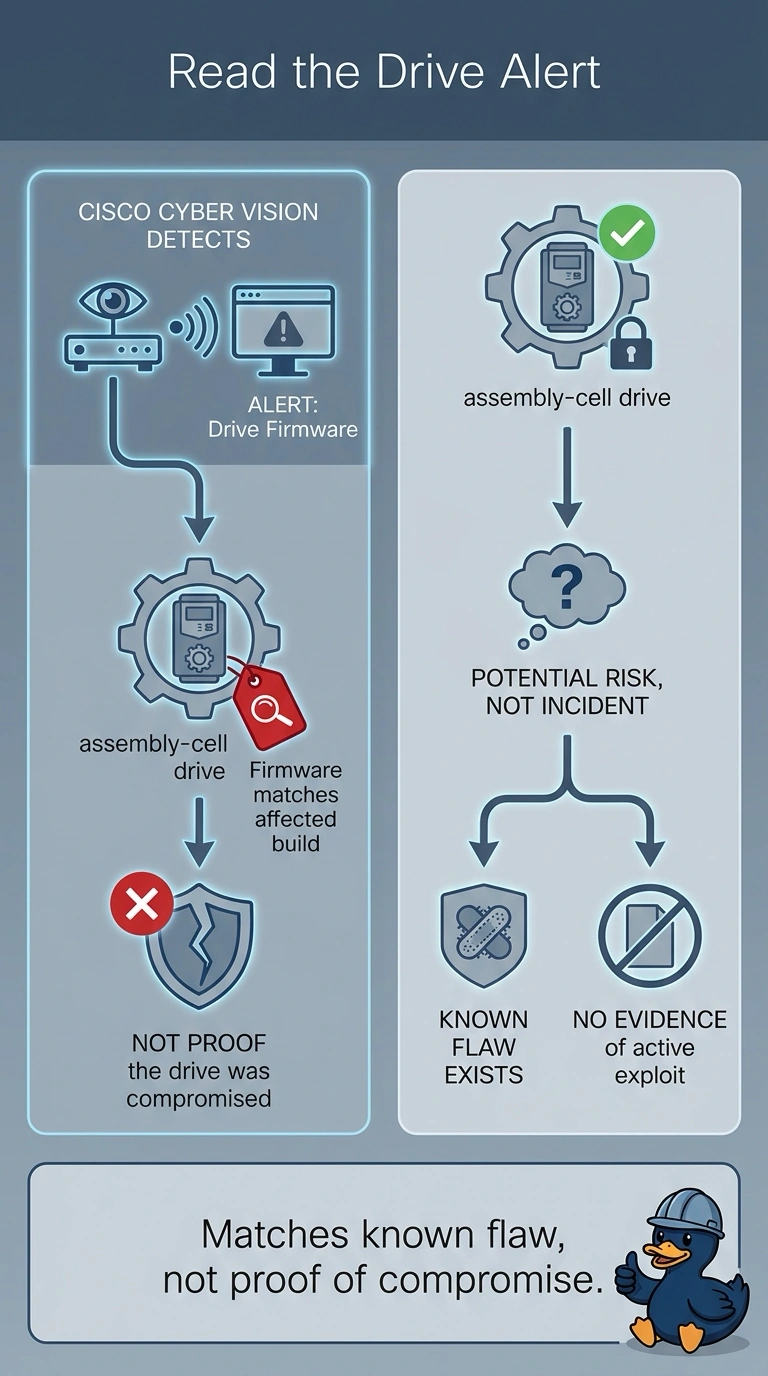
A nameplate that matches a recall is a fact about that one drive, not a confession that the whole line was hijacked. You are looking at a firmware match with no attack traffic beside it. Do not promote one drive into a plant-wide compromise.
Full Explanation
Cisco Cyber Vision can attach a known vulnerability to a component when the properties it observed, such as firmware, match the affected build. The fit reading is narrow: this assembly-cell drive looks like the vulnerable revision, and the event does not show attack traffic. That is a vulnerability in context, not a confirmed compromise. Treating every factory controller as already exploited inflates one firmware match into an incident the sensor did not report. A shared advisory identifier is not evidence that the rest of the line has been operated by an attacker. A DHCP lease renewal is an address assignment. It is not a firmware identity, and a decoder that matched a build is not inventing the flaw from a lease. GOOSE is a Layer 2 protection message used between substation devices. It does not write a firmware match onto a factory drive, and it is not the activity this report describes. Exam caveat: a firmware match can still be urgent on a drive that moves machinery, even with no exploit packet in the capture. Urgency is not the same claim as successful compromise. Operational check: compare the reported firmware with the version on the drive and with the advisory, then decide the maintenance window with the line owner.