
A pharmaceutical packaging-cell inventory records only an IP address for each controller. Which added facts make that inventory useful for OT risk decisions?
Select an answer to reveal the explanation.
Short Explanation
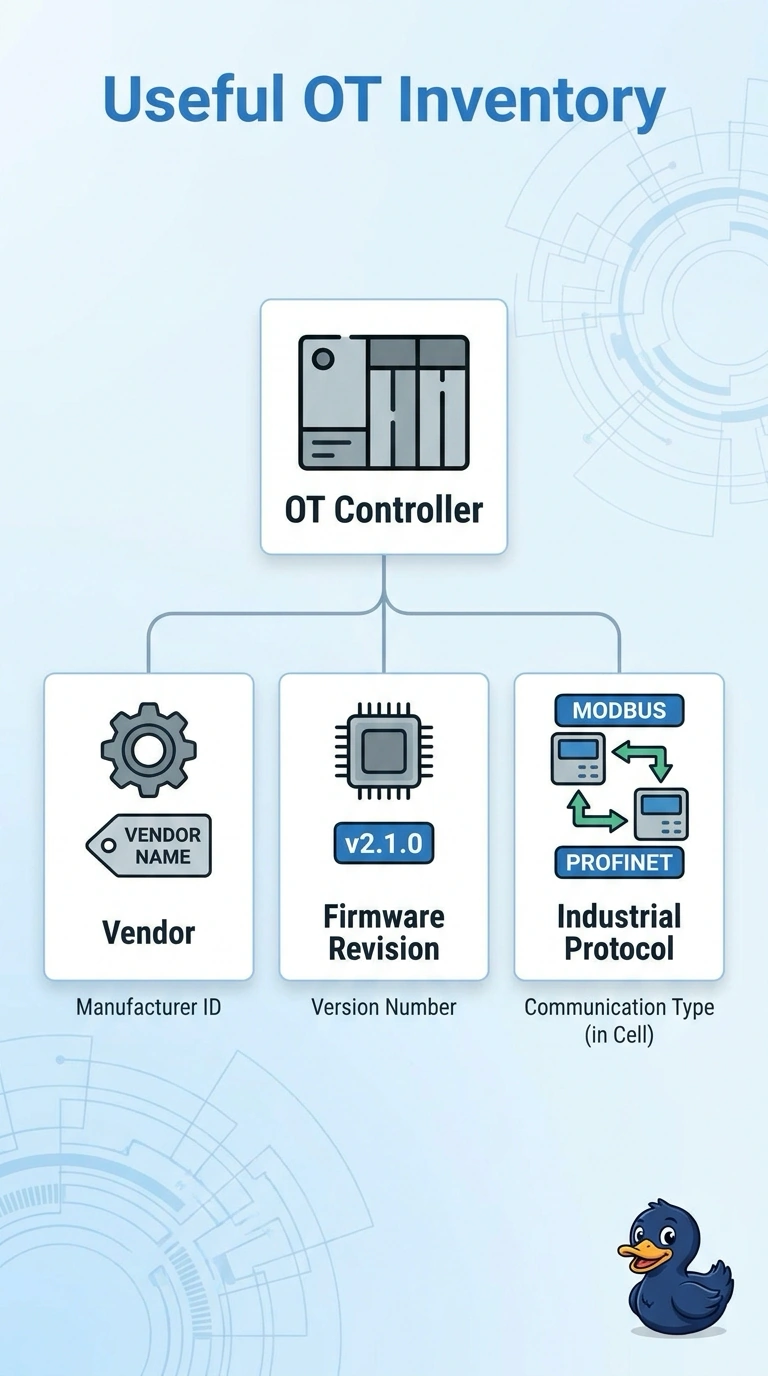
A phone list with no names will not tell you who can open the cabinet. You want the vendor, the firmware revision, and the protocol each packaging controller actually speaks. Printers, parking badges, and mailbox quotas do not rank a cell.
Full Explanation
An OT inventory is a risk tool only when it describes the asset that is actually on the wire. Vendor, firmware revision, and the industrial protocol tell you what the controller is, which image it runs, and how the cell talks to it. Those are the fields a packaging plant needs before it can match a flaw to a device or notice that a drive started speaking something the cell does not use. An IP address alone cannot do that job. Office printer models sit on a corporate VLAN. They do not identify a packaging PLC or its firmware. Parking-lot badge numbers are a physical-access record for the building. They do not describe a controller. Mailbox quotas on the enterprise mail server measure an office service. They have no bearing on which protocol the cell uses or which firmware is exposed. Exam caveat: an address list is still a useful starting sheet for reachability. It is not yet an OT inventory, and adding these three fields does not by itself rank which asset to treat first. Operational check: for one known packaging PLC, confirm the inventory shows the nameplate vendor, the firmware the engineering station reports, and the protocol seen between that PLC and its HMI.