
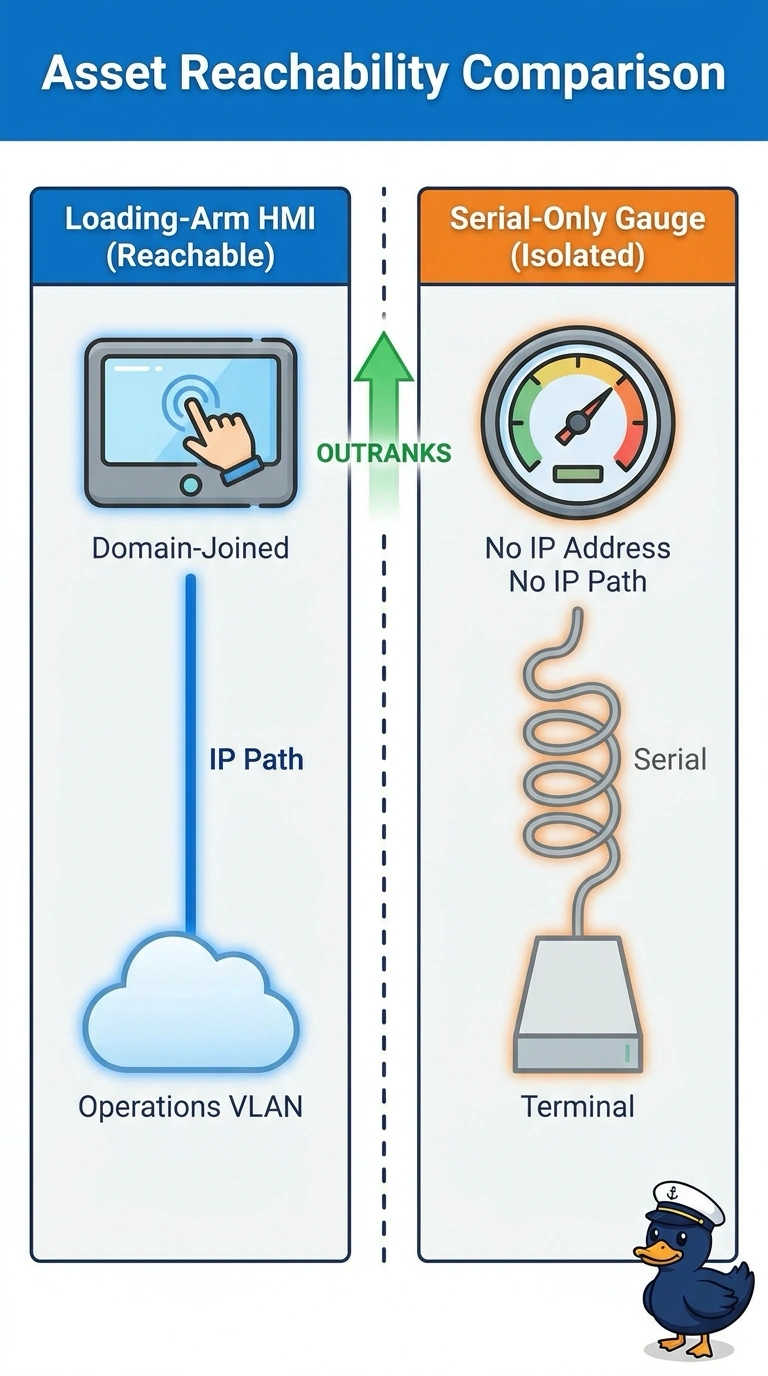
An oil terminal has the same vendor advisory on two assets. The loading-arm HMI is domain-joined on the operations VLAN. The tank-gauge controller speaks only serial and has no IP address. The serial controller has no remote-access gateway or other path from the operations network, and physical access is controlled. Assume comparable vulnerability exploitability and operational impact. Which risk reading is sound?
Select an answer to reveal the explanation.
Short Explanation
Two doors with the same cracked lock are not equal when only one opens onto a busy hall. You rank the loading-arm HMI higher while the serial gauge has no path from the network in this scenario. Matching advisory names is the trap that skips who can actually reach the asset.
Full Explanation
Risk here is the advisory combined with how the asset is used and whether an attacker can reach it. The loading-arm HMI is domain-joined and sits on the operations VLAN, so people and directory-side hosts can get to a system that already shares a common identity store. The tank gauge speaks only serial and has no IP address, so that same advisory has no network path today. The HMI is the higher immediate risk. Matching identifiers stop the analysis at the vendor bulletin and ignore exposure. The serial gauge is the harder target, not the easier one, precisely because nothing on the terminal LAN can address it. Waiting for a captured exploit packet confuses a vulnerability finding with an incident. The ranking exists so the terminal can act before that packet shows up. Exam caveat: the gauge's low exposure lasts only while it stays serial. The day a gateway gives it an IP address, the profile has to be written again. Operational check: confirm the gauge has no Ethernet address in the drawings or on the device, and confirm the HMI VLAN is reachable from the operations or directory network you are worried about.