
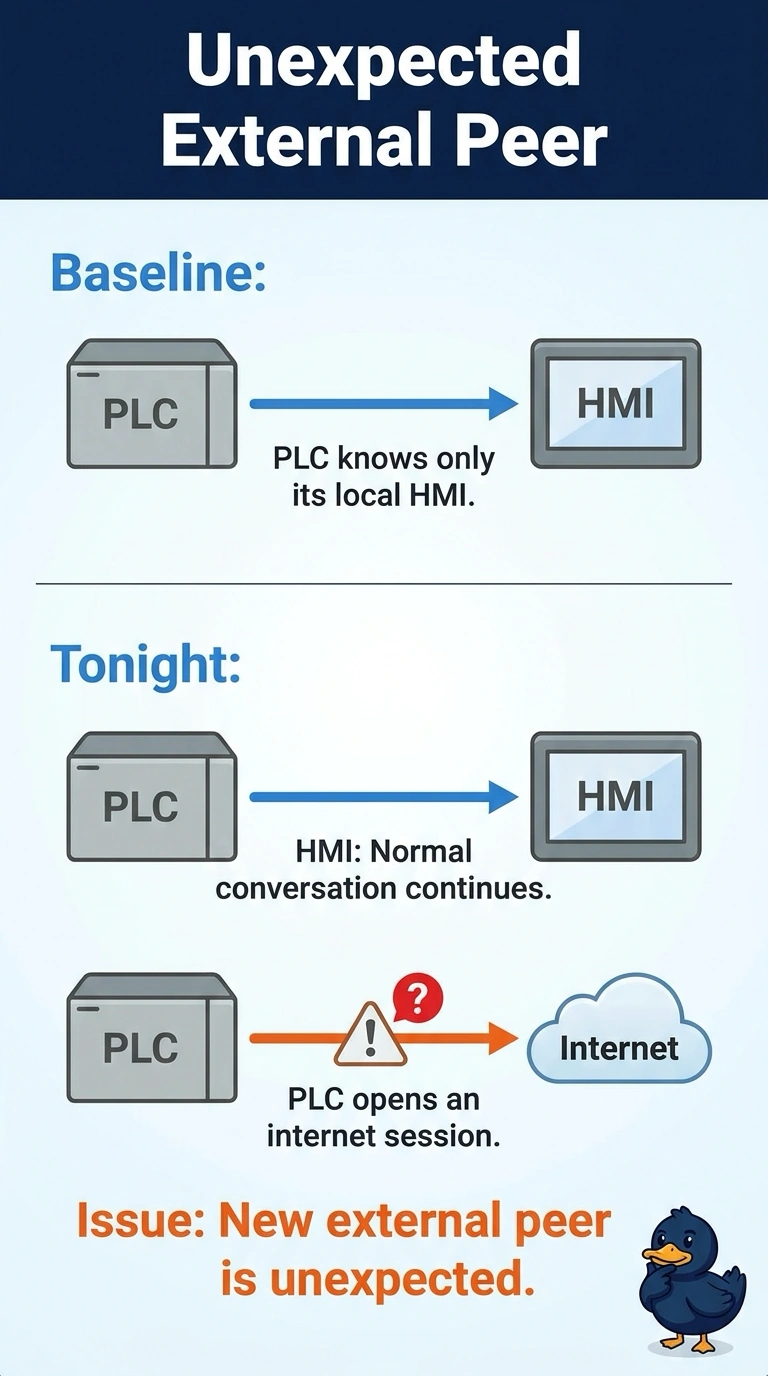
A grain-elevator PLC's baseline contains only its local HMI. Tonight that PLC opens a session to an internet address while the HMI conversation continues at its normal rate. Which issue is that?
Select an answer to reveal the explanation.
Short Explanation
You have a clear baseline: this PLC normally talks to its local HMI, and tonight it has added an internet destination. Treat that unexpected peer as the issue while leaving the usual HMI conversation alone. A historian copy or office wireless survey does not make the PLC an internet client.
Full Explanation
An OT baseline is the set of peers a controller is supposed to have. This PLC was only supposed to talk to its local HMI, so a new session to an internet address is an unexpected peer and the issue to investigate while the elevator keeps running. It could reflect malware, a mis-set default gateway, or something bridged behind the controller. The unchanged HMI conversation is the baseline at its normal rate; blocking it first could stop local operation while leaving the new destination unexplained. A nightly historian copy onto an enterprise file share is a plant-to-enterprise job, but the stem says the PLC opened a session to an internet address, not that the historian copy appeared as PLC traffic. An office wireless survey measures radios; it does not rewrite the PLC or make normal HMI traffic look like a public destination. Exam caveat: a site may intentionally publish a narrow telemetry flow, but that destination should already be documented in the baseline. An unnamed internet address without a ticket is not that design. Practical check: read the destination in the visibility event, confirm it is not a documented broker, and block it at the cell edge while operations checks the PLC for an unrequested change.