
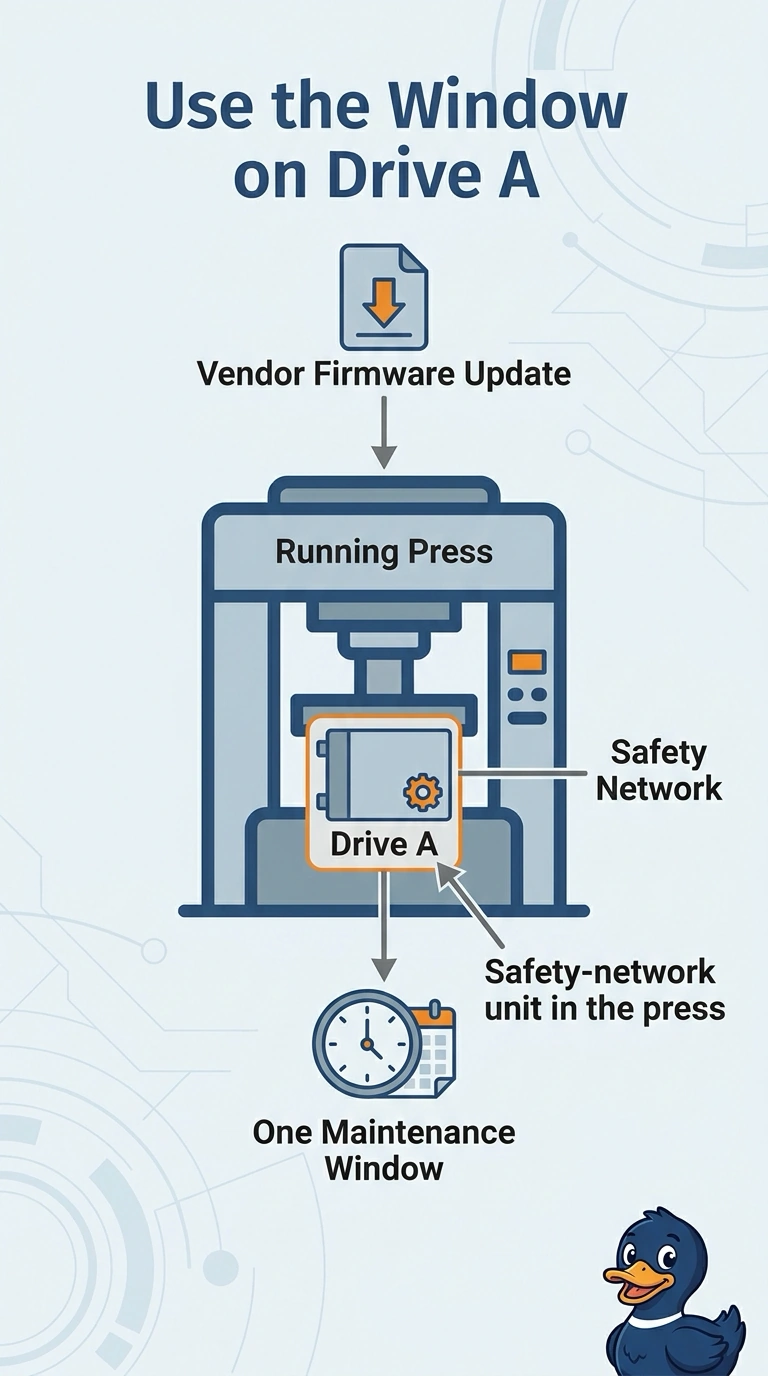
One maintenance window can take a vendor firmware update on a single drive. Two drives share the flaw. Drive A is on the safety network of a running press. Drive B is the same model on a bench with no network. Which choice fits?
Select an answer to reveal the explanation.
Short Explanation
You have one appointment and two patients, and only one of them is in the safety path of a running press. You spend the window on that drive. The bench unit can wait, and a stranger's firmware file is not how you fill the extra slot.
Full Explanation
Remediation spends a scarce window where the consequence is real. Drive A is on the safety network of the press, so a vendor firmware update there reduces risk on the function that can affect the machine. Drive B is the same model and the same flaw, and it has no network and no process role until someone installs it. The fitting choice is to use the window on drive A and schedule the bench unit later. Updating the bench first because it is easier leaves the exposed safety drive unchanged for the sake of a simpler job. Loading an untested forum image on both drives adds an unknown image to a safety function and does not follow the vendor update the window was for. Skipping both because the window cannot cover every asset wastes a chance to fix the drive that is actually in service. A partial window is still useful when it is aimed at the higher consequence. Exam caveat: the update still has to be the vendor image, tried on a representative drive before it touches the press, and operations has to own the window. Easier is not the ranking. Operational check: the change ticket should name drive A, the safety network, and the vendor image, and drive B should stay out of that window's scope.