
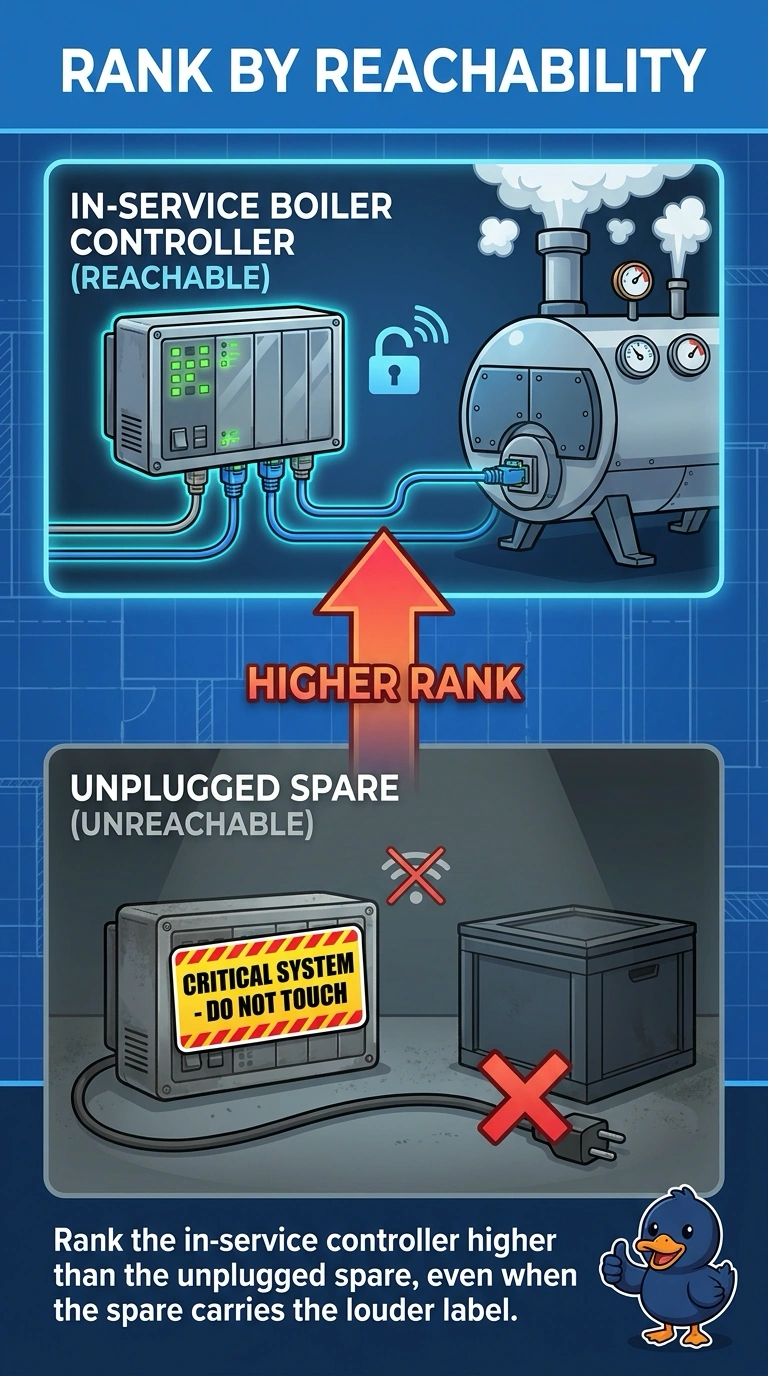
A visibility tool marks a critical flaw on a boiler-controller spare that is unplugged in a storeroom, and a medium flaw on the in-service boiler controller the enterprise can route to. Which ranking fits?
Select an answer to reveal the explanation.
Short Explanation
A red tag on a part in a box is not the same as a yellow tag on the boiler that is holding pressure and still has a path from the office. You rank the running, reachable controller first. The trap is sorting the list by the severity word and never asking what is plugged in.
Full Explanation
A risk profile uses the finding together with exposure and consequence. The in-service boiler controller is running the process, and the enterprise can route to it, so a medium flaw there is an immediate operational problem. The spare carries a harsher label and is unplugged in a storeroom. Nothing can reach it, and it is not in the process, so it is not the higher immediate risk. Sorting only by the words critical and medium ignores that difference and would send the team to a shelf while the live controller stays exposed. Calling the findings equal until the words match refuses to use the path and the role, which is what the profile is for. Waiting for an exploit packet against the spare confuses a vulnerability ranking with an incident on a device that is not even powered. Exam caveat: the spare becomes urgent the day someone installs it. Keep the critical finding on the work list, behind the reachable boiler. Operational check: confirm the enterprise route to the in-service controller, and confirm the spare has no cable and no switch port before you defer it.