
A warehouse spreadsheet lists every PLC by serial number and nothing else. A firewall change is waiting on that list. Which addition makes the inventory useful for the change?
Select an answer to reveal the explanation.
Short Explanation
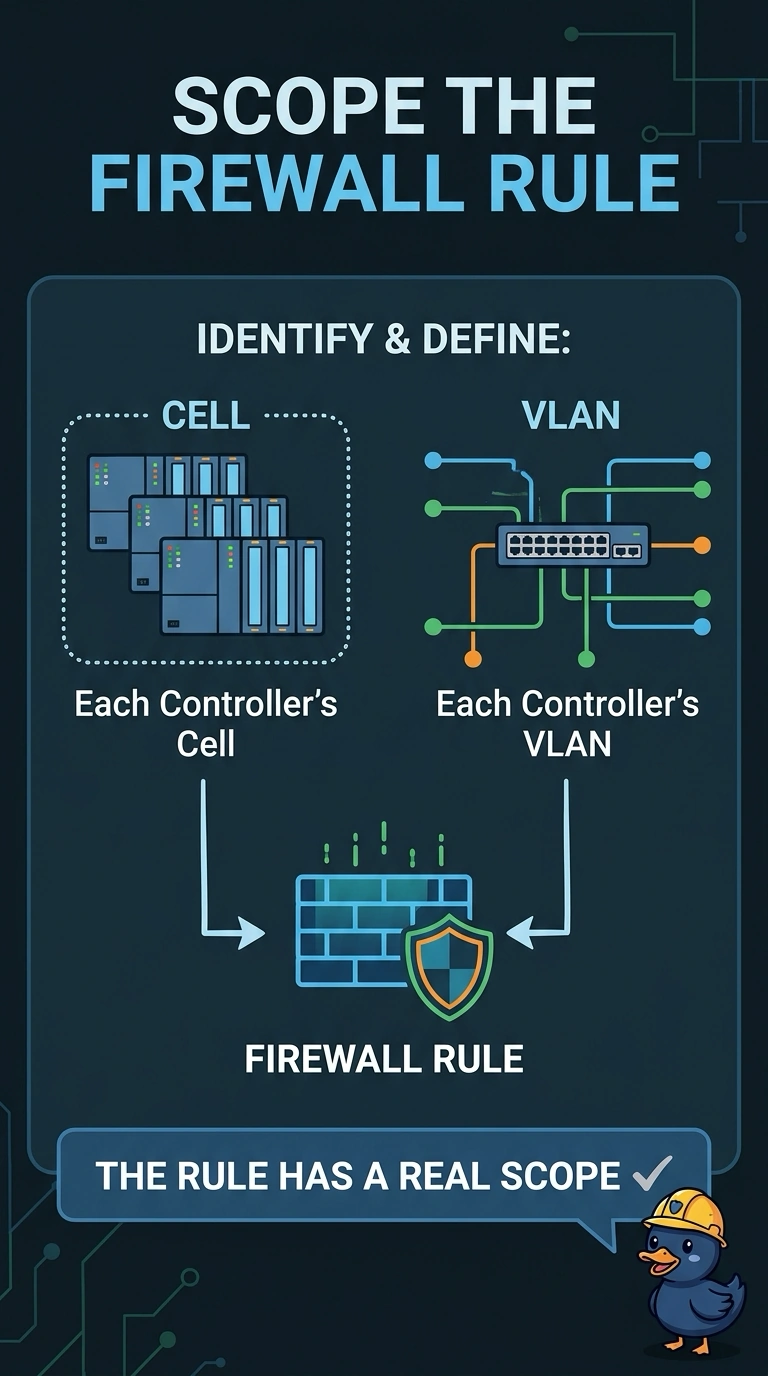
A serial number tells you which box you own, not which doorway that box uses. You add the cell and the VLAN before anyone writes a firewall rule from that list. The trap is thinking a nameplate is a network map.
Full Explanation
A firewall rule needs a source, a destination, and a place in the path. The cell and the VLAN are what tie a serial number to that path. Without them the change is a guess about which PLC is which. Cabinet color does not identify a subnet or a conduit. The person who walked past the skid is not a flow. A photograph of the nameplate still omits where the controller sits in the network, so it cannot scope the rule by itself. The caveat is that the serial number still belongs in the record for recalls and firmware matching. The check is to pick one PLC, find its access VLAN on the switch, and confirm the spreadsheet now names that VLAN. Put the before-and-after evidence in the work order, including the interface or account you changed, the time, and the person who approved it. On the next shift, confirm the original symptom is gone and that the change did not open a second path while closing the first. If the process is still inside a live batch, leave the controller running and finish only the part of this work that does not restart it. That sequence keeps a correct fix from turning into an unplanned outage.