
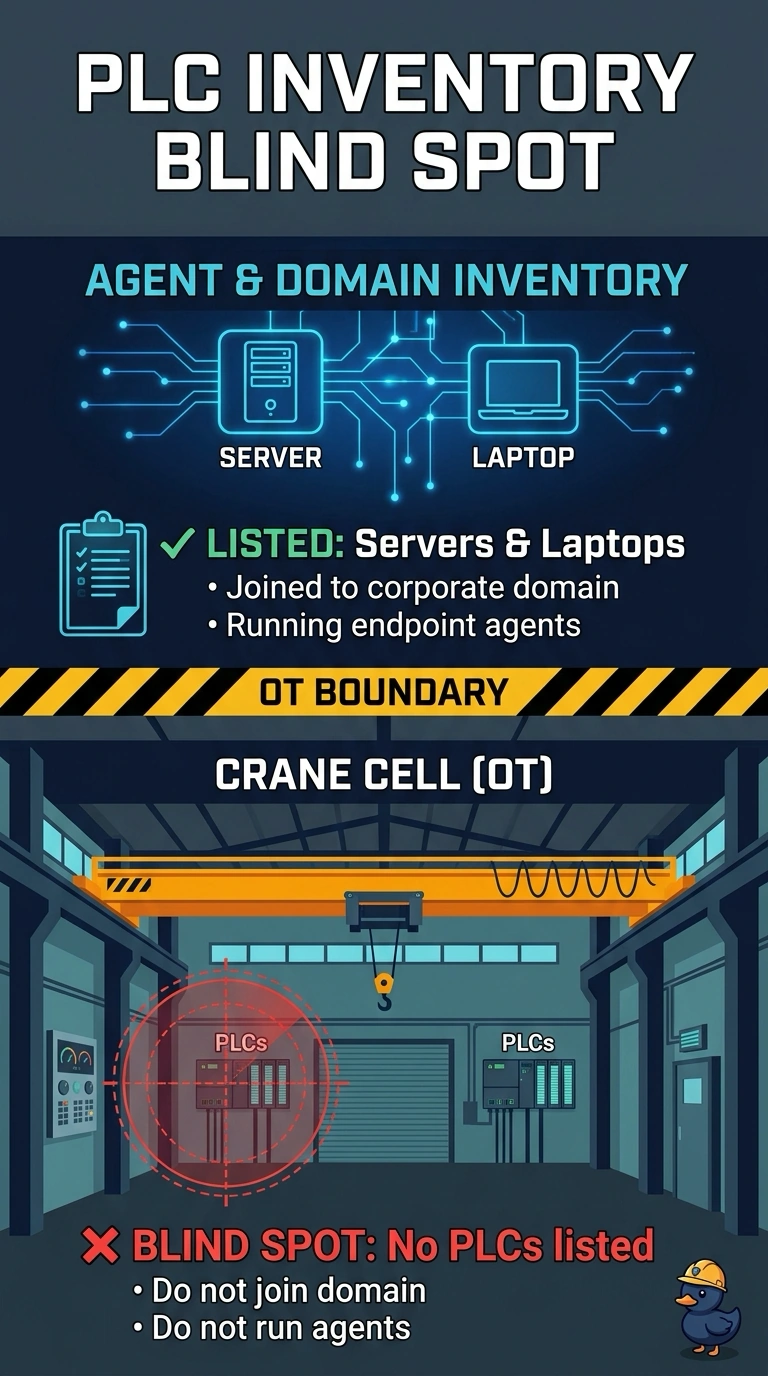
A port's IT configuration database lists servers and laptops and shows no PLCs for the crane cell. Those PLCs do not run an endpoint agent and do not join the corporate domain. Which visibility gap is this?
Select an answer to reveal the explanation.
Short Explanation
An office roll call that only hears people wearing a company badge will miss the machines that never wear one. You will not see these crane PLCs in a database built from domain joins and endpoint agents. A wireless survey and a quarterly laptop audit do not speak the controllers' protocols.
Full Explanation
An IT configuration database fed by domain joins and endpoint agents only knows hosts that participate in those mechanisms. The crane PLCs do neither, so an empty PLC list is the expected gap, not proof that the cell has no controllers. The visibility that closes it has to learn industrial assets from their own traffic or from an inventory method that does not require a Windows agent. Calling the database complete because a quarterly office software audit will run keeps looking in the same place. Office software audits see managed computers. They do not enumerate a PLC that never joins the domain. A wireless channel survey measures radios and signal levels. It does not report PLC vendor, firmware, or logic version for controllers on a copper cell network. Passive copies of cell traffic can identify those PLCs precisely because the method does not ask them to join a domain. It reads the protocols they already speak. Saying a passive copy cannot see a PLC that refuses a domain join reverses how OT discovery works. Exam caveat: a traffic-based inventory still misses a controller that is powered and silent. Pair it with the panel drawings when a slot in the cell shows no conversations. Operational check: compare the IT database with a passive discovery of the crane VLAN and expect the PLCs to appear only in the passive list until the asset records are reconciled.