
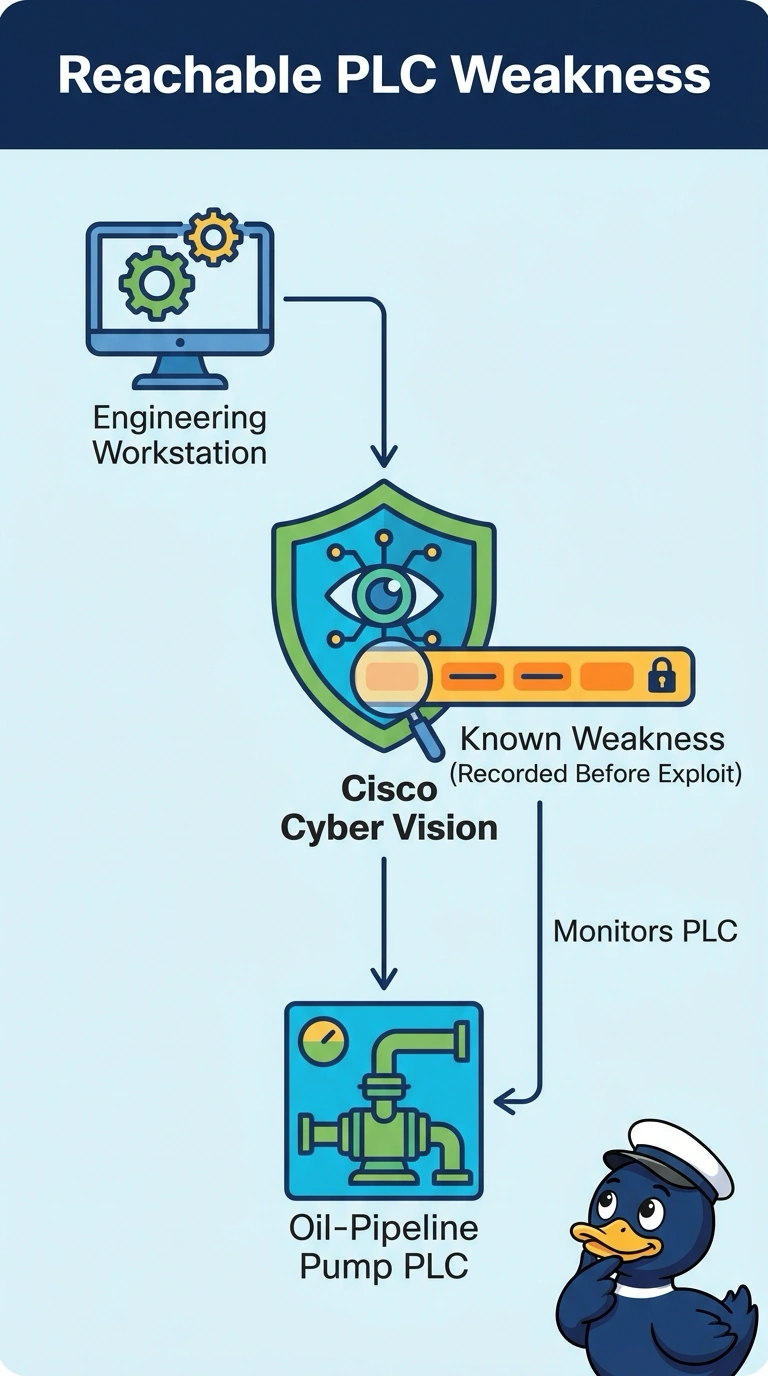
Cisco Cyber Vision associates a known vulnerability with one oil-pipeline pump PLC that the engineering workstation can reach. No exploit traffic has been observed. Which reading of that event fits?
Select an answer to reveal the explanation.
Short Explanation
A crack noted on one pump is a maintenance fact, not a rumor about every pipe and not proof that someone already broke in. You read the event as a known weakness on a pump PLC the engineering workstation can reach. Treat that component's exposure as real while you confirm that no exploit traffic has been seen.
Full Explanation
Cisco Cyber Vision reports vulnerabilities in the context of a component it has observed, not as a floating bulletin. Here the known weakness is tied to one pump PLC, and the engineering workstation can reach that PLC. No exploit traffic has been seen. The sound reading is a weakness on this reachable controller that belongs in that asset's risk picture now, before anyone claims an intrusion. Proof of rewritten logic would be a different observation, such as a logic or firmware change, and this event does not say that. A vulnerability record is not an incident report. Discarding the entry because no exploit packet was captured confuses a weakness with an attack in progress. Risk is ranked so the plant can act before that packet. Treating the finding as equal for every asset on the pipeline drops the part the sensor actually provided: this component, this reachability. A pump the engineering station can touch is not the same case as a device the report did not name. Exam caveat: the entry still does not name an attacker or a time of compromise. It tells you where a known weakness sits and that a path exists. Operational check: open the event, confirm the pump PLC identity and the workstation path, and match it to the maintenance record before anyone calls it either a false sensor or a completed intrusion.