
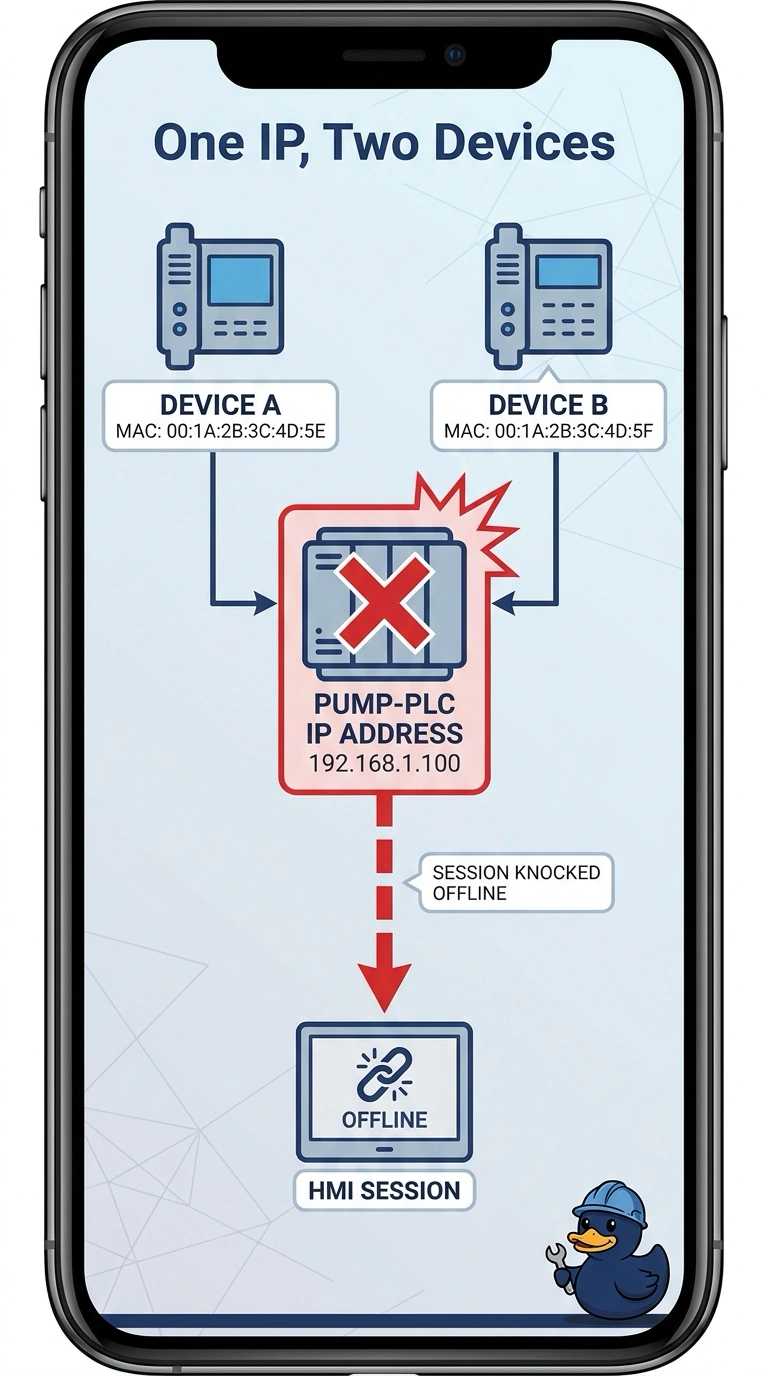
On a water-distribution cell with no redundant controller pair, the visibility tool shows two MAC addresses answering for one pump-PLC IP and the HMI session keeps dropping. Which issue is that?
Select an answer to reveal the explanation.
Short Explanation
Two radios answering to the same call sign will step on each other until nobody gets a clear order. You are seeing two MAC addresses fight over one pump-PLC IP while the HMI session keeps dropping. A normal drive cycle does not borrow the controller address and break the operator session.
Full Explanation
A duplicate-address condition means two endpoints are answering for one IP. The cell has no redundant controller pair, two MAC addresses are seen for the pump-PLC address, and the HMI session keeps dropping as the conversation changes hands. That is an address conflict on the cell, and visibility is right to surface it as an anomaly. A drive heartbeat does not echo the PLC IP as a second MAC. Cyclic traffic uses the peers and addresses the baseline already knows, and a fast HMI poll does not create a second hardware address. Sharing one IP between a PLC and its drive, then dropping the HMI as a keepalive, is not how a non-redundant pump controller is built. The stem rules out a designed redundant pair, so the shared-address story does not fit. A full historian disk can stop archiving. It does not make two MACs answer for the PLC, and a storage fault is not what the sensor described. Exam caveat: some redundant pairs do advertise one virtual address on purpose. This cell has no such pair, so two MACs are a conflict until someone proves a change. Operational check: map both MACs to switch ports, identify the unexpected device, and remove it so only the pump PLC answers for that address.