
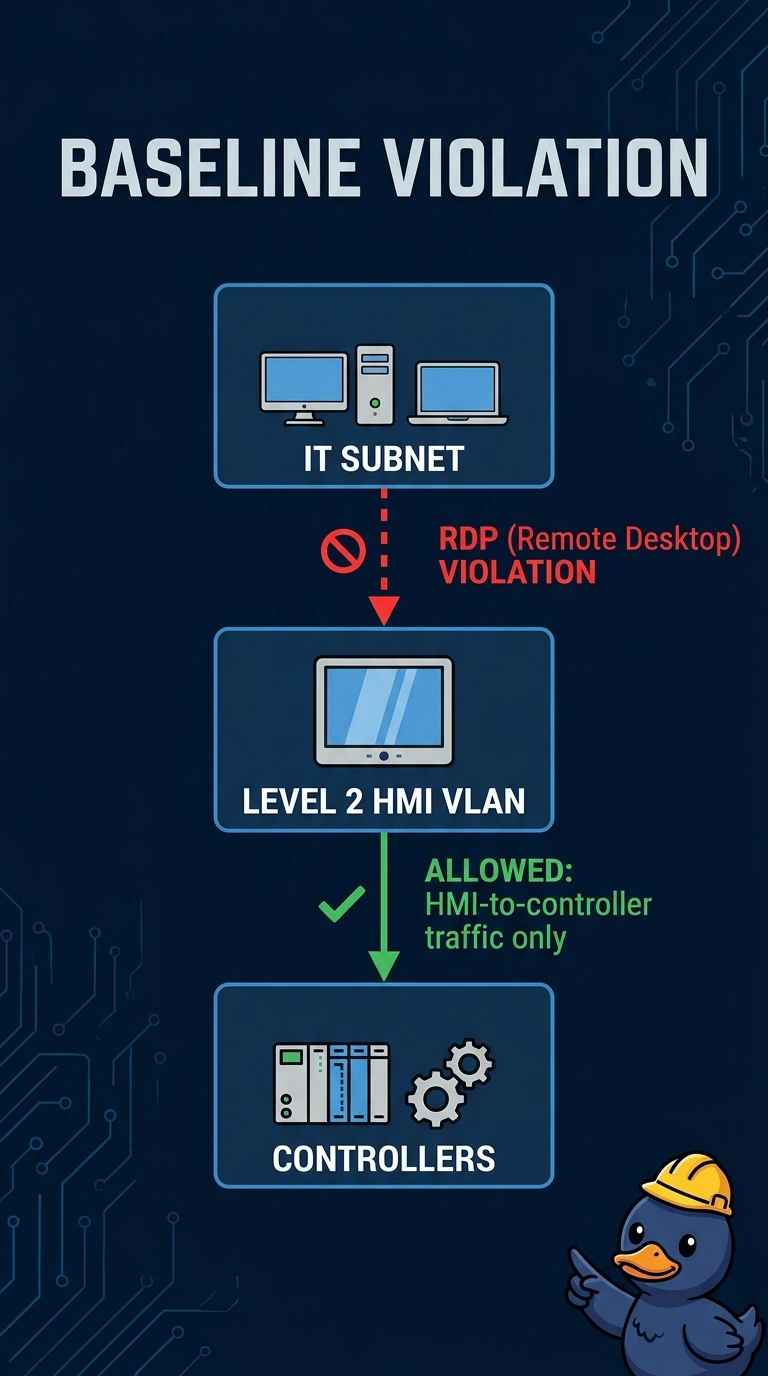
A tire plant's visibility tool shows remote-desktop sessions from an IT subnet into the Level 2 HMI VLAN. The baseline for that VLAN is HMI-to-controller traffic only. Which issue is that?
Select an answer to reveal the explanation.
Short Explanation
You’re right to flag remote desktop from the IT subnet: the baseline allows HMI-to-controller traffic, not an interactive desktop path into the HMI VLAN. That’s a protocol deviation; a local Modbus read, a normal HMI tag poll, or one-way historian-tag forwarding does not explain the observed session.
Full Explanation
The baseline for the Level 2 HMI VLAN is HMI-to-controller traffic, so remote desktop arriving from the IT subnet uses a different protocol and an unapproved direction of communication. It creates an interactive administrative path from the business network into the HMI VLAN, making it a protocol deviation and an unauthorized path unless an approved design or access record explains it. A Modbus read from the local HMI is plausible process traffic, but it originates at the HMI and is not remote desktop from the IT subnet. A normal HMI poll of a controller tag fits the stated baseline; the tool’s display does not turn that poll into a desktop session. A data diode forwards data in one direction, typically out of the plant, and does not use remote desktop to forward historian tags, so it cannot account for the observed inbound interactive session. The key distinction is the observed protocol and source versus the permitted traffic. Exam caveat: a brokered support session may be legitimate when it uses an approved jump path and appears in the access log; an unexplained remote-desktop flow directly from an IT subnet is not that design. Practical check: verify the source address against the approved jump host and access records, then block the IT subnet from the HMI VLAN if the path is not approved.