
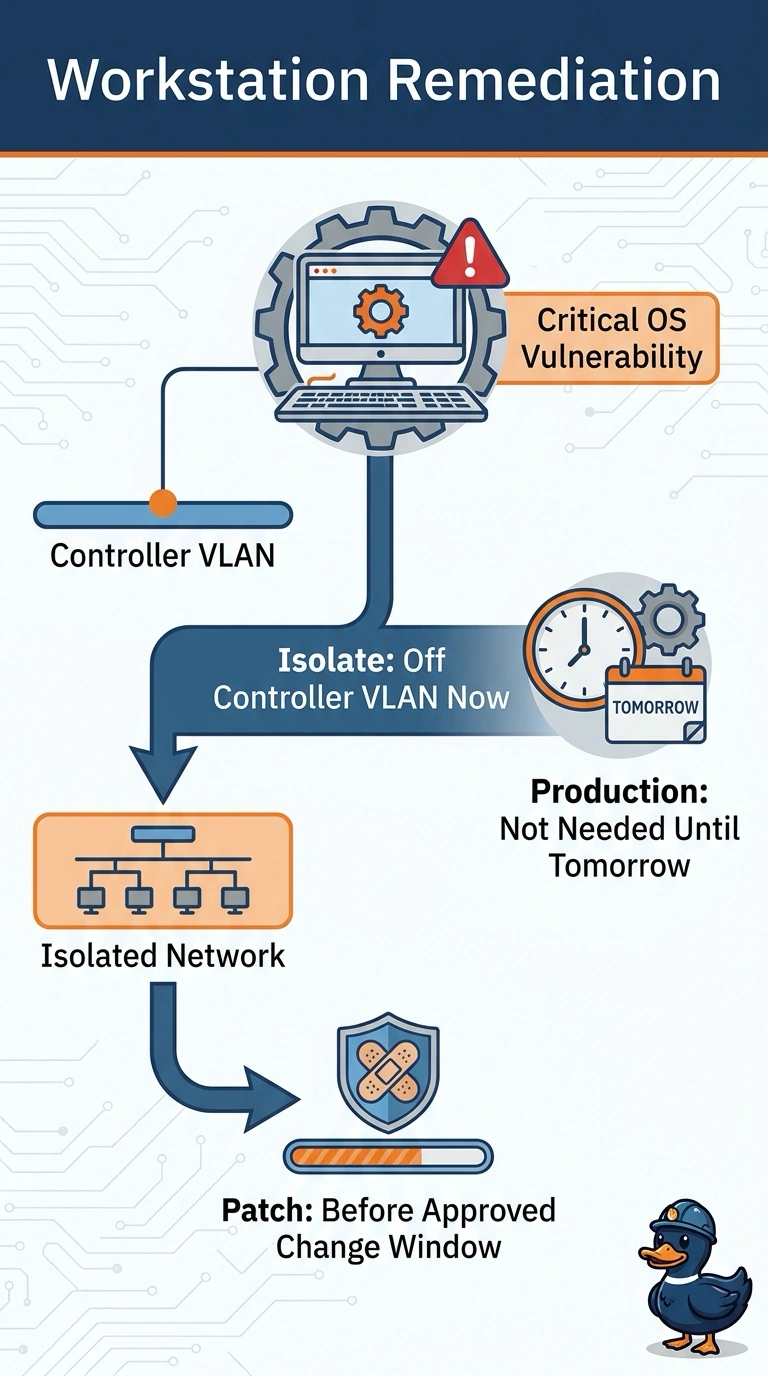
A brewery engineering workstation has a critical operating-system vulnerability. It is not a controller, and production does not need it until tomorrow's change window. Which remediation fits?
Select an answer to reveal the explanation.
Short Explanation
This machine is a toolbox, not the kettle. You can take a toolbox out of the room without stopping the brew, and you should, because the flaw is on the workstation. Rebooting the PLCs does not patch Windows, and ignoring the box because it is not a PLC leaves a programming station on the wrong network.
Full Explanation
Risk-based remediation asks what the asset does and what an outage costs. This workstation is not in the control loop tonight. Production does not need it until a change window that already exists tomorrow. Removing it from the controller VLAN cuts off the path an attacker would use to pivot into the PLCs, and patching it before that window removes the flaw before it is connected again. That is a proportionate fix. Leaving it on the controller VLAN because the flaw is in Windows treats the label IT as a reason to ignore reachability. A programming station on the cell network is an OT path regardless of the operating system. Rebooting PLCs does not change the workstation's missing patches and adds process risk for no gain. Formatting the machine and deleting the engineering software during the brew is a larger outage than the problem requires, and it throws away the tool the window was meant to use. Exam caveat: confirm the workstation is not also the only HMI. This stem says it is an engineering station that production does not need tonight. An HMI the operators are using would be a different weighing. Operational check: disconnect it or move the port to a quarantine VLAN, apply the vendor-approved patches offline, and scan or review the host before it returns to the engineering network.