
Cisco Cyber Vision shows the firmware version on a cement-kiln PLC no longer matches yesterday, and no change ticket exists. Which reading of that event is appropriate?
Select an answer to reveal the explanation.
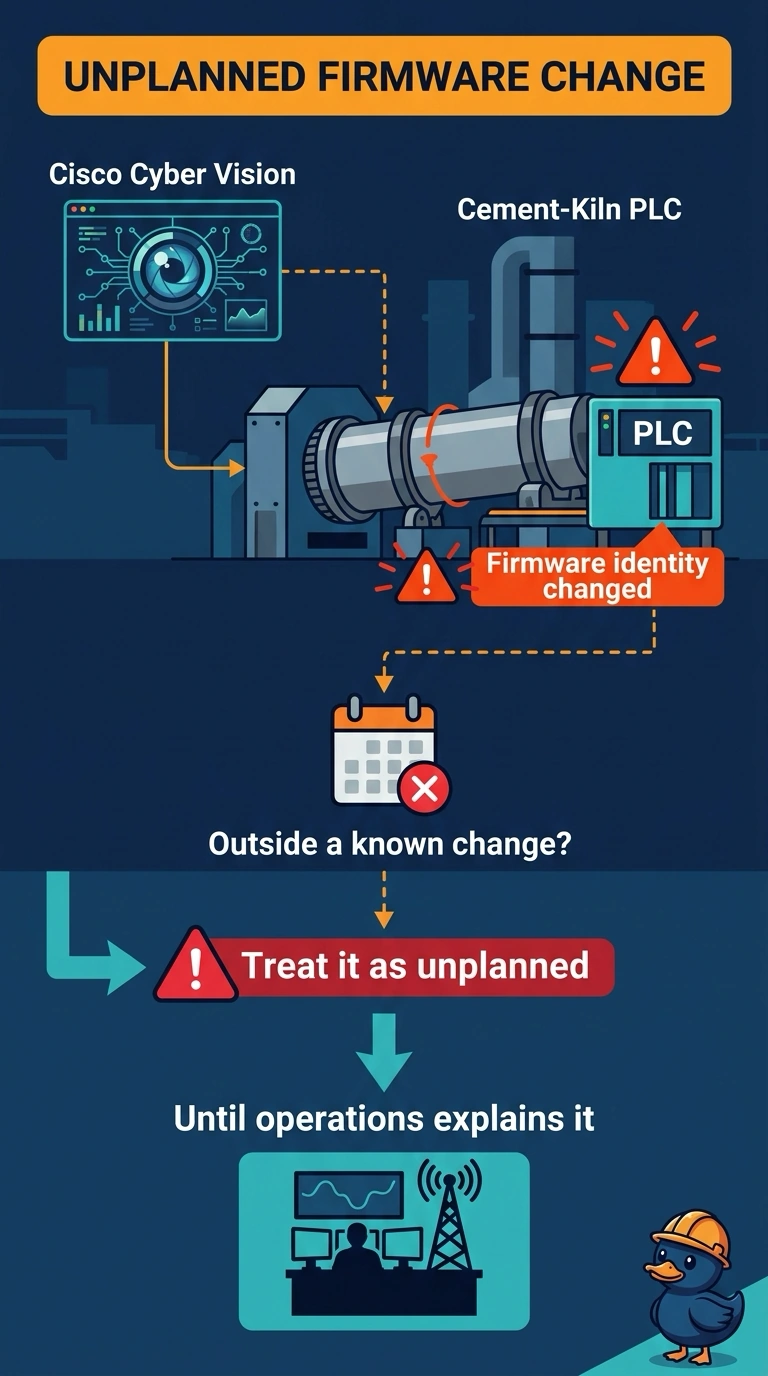
Short Explanation
Yesterday this kiln PLC had one firmware identity, and today it has another, with no ticket on the board. You treat that like a part that was swapped while nobody was looking, until the people who run the kiln can explain it. A spreadsheet backup does not rewrite controller firmware.
Full Explanation
Cisco Cyber Vision can track properties it has observed for a component, including the firmware identity it learned from traffic. A change in that version, with no matching change ticket, means the device no longer matches the last known good observation. The appropriate reading is an unplanned modification until the kiln team shows a maintenance action that accounts for it. A lost traffic copy stops new observations. It does not rewrite a stored firmware field into a newer version, so that reading does not explain the event. An enterprise backup of a spreadsheet restores a file on a server. It has no path that writes PLC firmware as a side effect. A wireless site survey measures radios. It does not load controller firmware, and a guest network should not have a path to do so. Those three readings invent a harmless cause the event does not support. Exam caveat: fingerprinting can occasionally shift when a device starts advertising a second string, such as a boot image versus a running image. You still confirm with operations and, if needed, with the vendor's view of the controller, rather than deleting the event. Operational check: compare the reported version with the kiln maintenance log and with the version the engineering workstation shows for that PLC, and open an incident if nobody performed the change.