
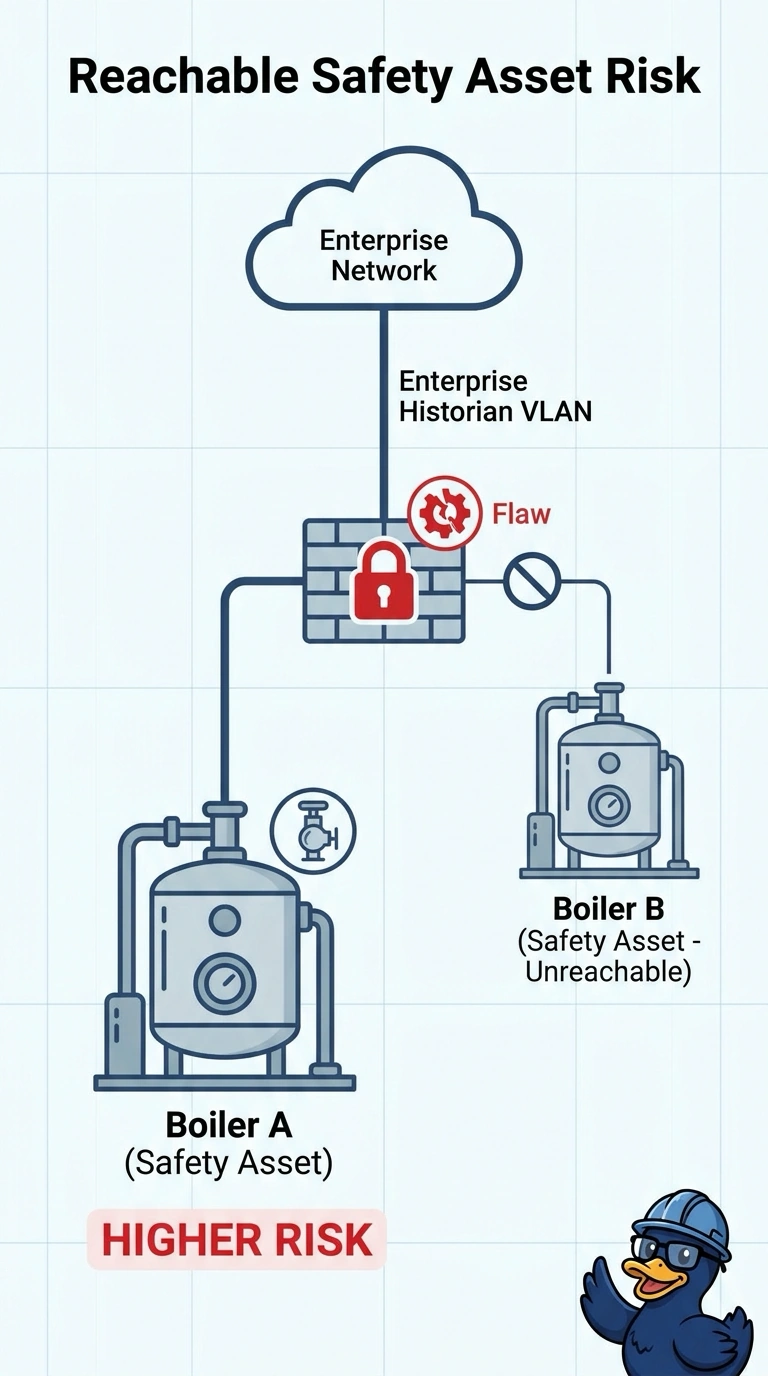
Two boilers show the same firmware vulnerability. Boiler A is a safety controller with a routed path from the enterprise historian VLAN. Boiler B is an identical spare on a bench with no uplink. Which risk reading is sound?
Select an answer to reveal the explanation.
Short Explanation
A crack in a spare part on the shelf is not the same crack in the boiler that is holding pressure, especially when the office network can still route to it. You weigh the safety role and the path in, not just the matching flaw name. Waiting for an exploit packet before you admit risk leaves you late.
Full Explanation
An asset risk profile combines the weakness with how the asset is used and how it can be reached. Boiler A is in a safety role and has a routed path from an enterprise VLAN, so a flaw an attacker can try to reach is operationally urgent. Boiler B has the same firmware weakness, but it has no uplink. It cannot affect the plant until someone connects it, so its current operational risk is lower even though the identifier matches. Treating the two as equal stops the analysis at the vulnerability database and ignores exposure and consequence, which is what the visibility finding is for. Calling the isolated bench the higher risk reverses reachability: the spare is the harder target precisely because nothing routes to it. Waiting for a captured exploit packet confuses a vulnerability finding with an incident. Risk exists before the packet, and the profile is how you decide what to do first. Exam caveat: if the spare is later installed, its profile changes the day it gains a path. Record that. A high score on an isolated spare still belongs on the work list, just not ahead of the reachable safety controller. Operational check: for Boiler A, trace the route and the ACL from the historian VLAN to the safety network and confirm whether that path is required at all.