
On a mining-conveyor trunk, the native VLAN is the same VLAN as the conveyor PLCs. Which risk does that choice create?
Select an answer to reveal the explanation.
Short Explanation
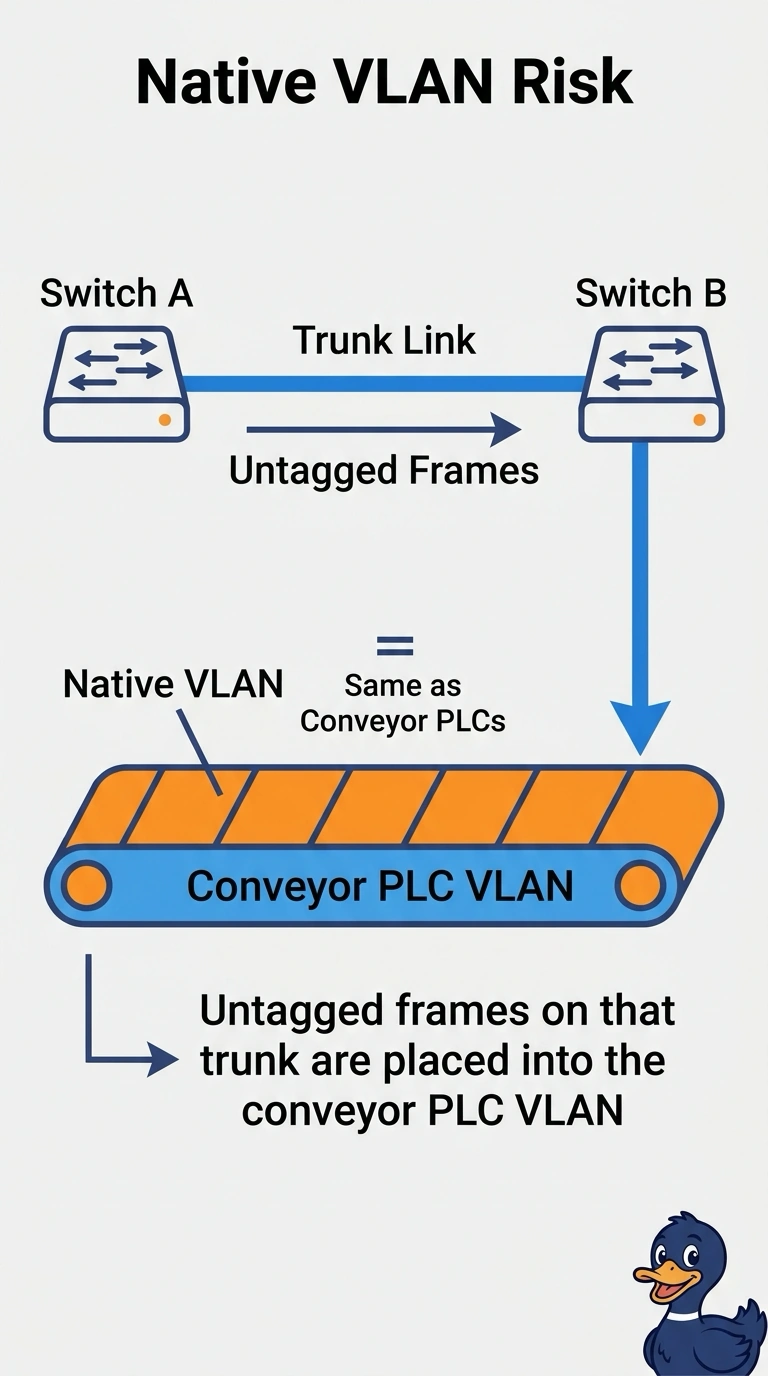
The native VLAN is the unmarked bin on a trunk, and anything without a tag falls in. You pointed that bin at the conveyor PLCs, so stray untagged frames join the cell. Calling the native VLAN a harmless label is how the door stays open.
Full Explanation
On an 802.1Q trunk the native VLAN is carried untagged by default. Frames that arrive without a tag are placed in that native VLAN. Here the native VLAN is the conveyor PLC VLAN, so untagged frames enter the broadcast domain that holds the controllers. That is the risk this choice creates. The belief that untagged trunk frames are simply discarded treats the native VLAN as a harmless name. On this switch those frames are delivered into the PLC VLAN, not dropped. Selecting a VLAN as native does not encrypt it. Encryption is a separate control and is not a property of the native setting. Native-VLAN frames normally leave this trunk untagged unless native tagging is enabled; frames are not reassigned to the enterprise VLAN merely by selecting a native VLAN. A device that sends untagged frames, such as a misconfigured laptop, then shares the PLC broadcast domain. Exam caveat: the two ends of the trunk should agree on which VLAN is native. Agreement does not remove the risk if the VLAN they agree on is the PLC VLAN, because untagged frames would still land in the cell. Operational check: show the trunk status on the conveyor switches and confirm the native VLAN is not the conveyor PLC VLAN.