
A review of a Cisco IE switch in a grain cell finds the finger service still willing to answer queries. Nothing in the cell uses it. Which hardening step fits?
Select an answer to reveal the explanation.
Short Explanation
Finger is a leftover doorbell that tells strangers who is inside. You turn it off when the cell does not use it. The trap is keeping a lookup service because it once felt handy on a campus switch.
Full Explanation
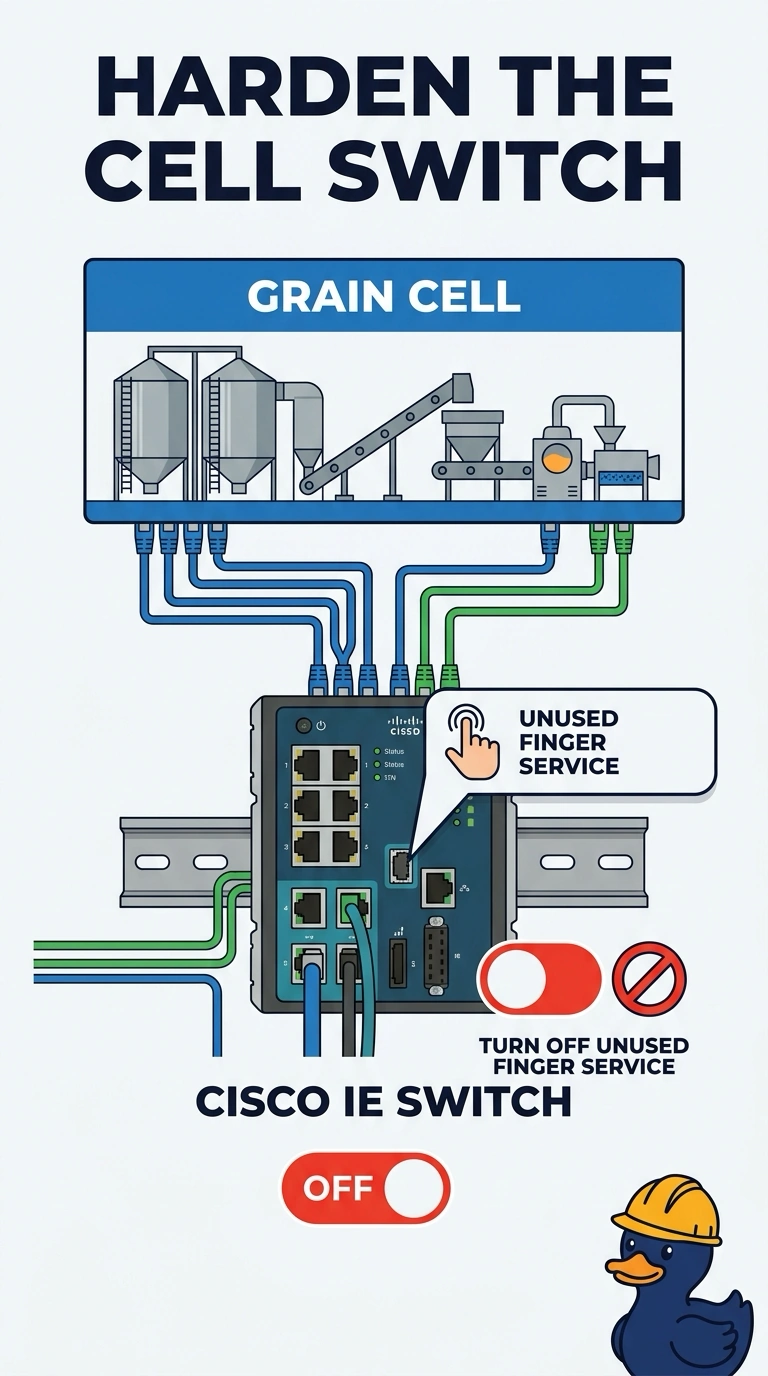
IOS small services such as finger answer questions a cell switch does not need to answer. no ip finger, or the equivalent no service finger on older images, disables that listener. An unused listener is one more place a probe can start. Leaving it for visiting techs exposes session information on a network where management should already be SSH from known stations. Forwarding those queries to a domain controller ties the cell switch to an office directory for no operational gain. Putting the service on the PLC VLAN asks controllers to participate in a user-lookup protocol they do not speak. The caveat is to confirm the image actually has the service enabled before you treat a hardened box as a finding. The check is a probe from the management station: the switch should not answer finger, and SSH should still work. Put the before-and-after evidence in the work order, including the interface or account you changed, the time, and the person who approved it. On the next shift, confirm the original symptom is gone and that the change did not open a second path while closing the first. If the process is still inside a live batch, leave the controller running and finish only the part of this work that does not restart it. That sequence keeps a correct fix from turning into an unplanned outage.