
On a Cisco IE trunk between two water-plant cell switches, the PLC VLAN is configured as the native VLAN. Which baseline change fits?
Select an answer to reveal the explanation.
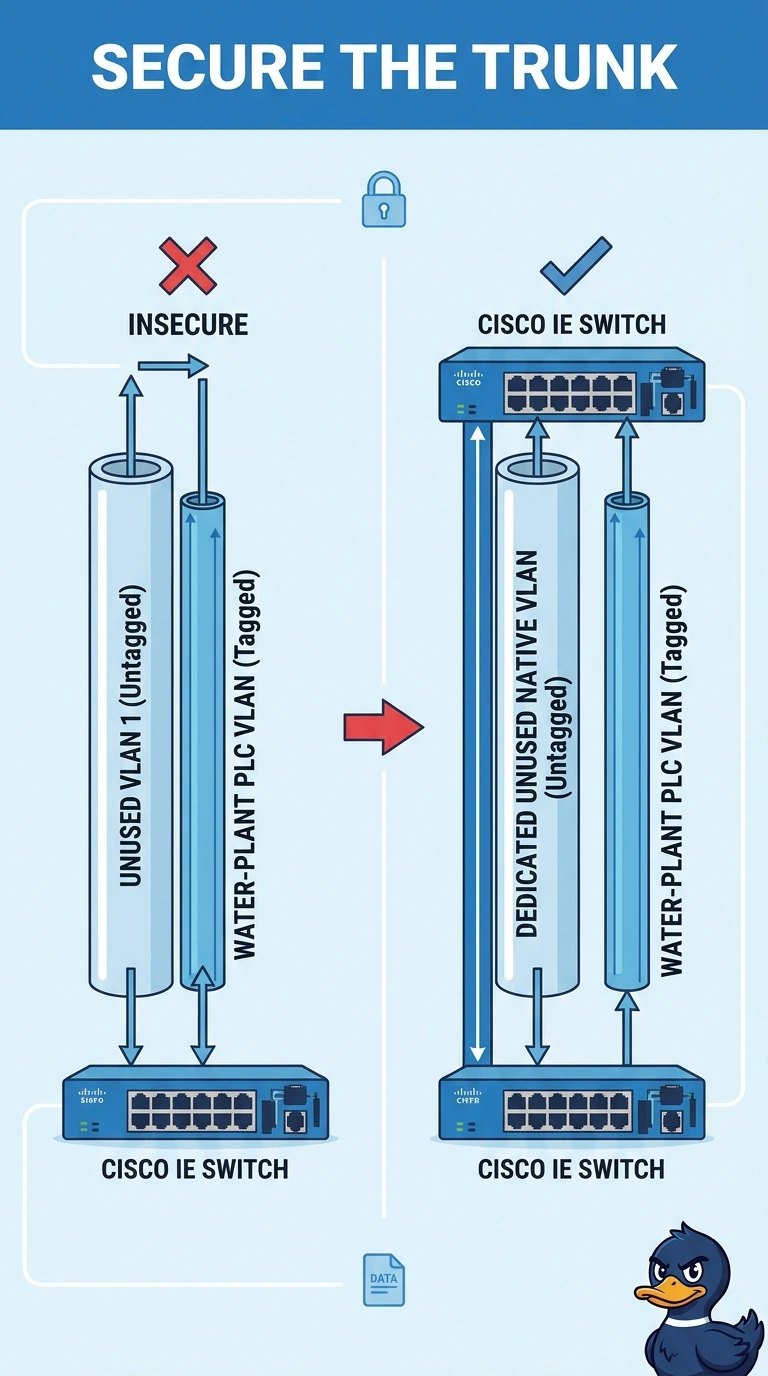
Short Explanation
The native VLAN is the unmarked lane on a trunk, and you do not put the PLC traffic in the unmarked lane. You tag the water-plant control VLAN and you park native on a VLAN nothing uses. Untagging the controllers onto the enterprise lane widens the mistake.
Full Explanation
On an 802.1Q trunk the native VLAN is the VLAN carried untagged. Best practice is to make that an unused VLAN so untagged frames are not the plant's control traffic, and to carry the PLC VLAN with tags. Tagging the water-plant controllers keeps their frames distinct from a device that shows up with no tag at all. An unused native VLAN should not have hosts, so a stray untagged frame has no useful place to land. Leaving the PLC VLAN native puts control frames in the unmarked lane, where a misplugged device or a double-tagged frame has an easier time blending in. That is the opposite of the baseline. Moving the native VLAN to the enterprise data VLAN and untagging the PLCs onto it dumps the controllers into the business network. Turning tagging off collapses the trunk. Every VLAN cannot cross as untagged traffic, and the cell separation the trunk was built to keep disappears. Exam caveat: both ends of the trunk have to agree on the same native VLAN. Changing only one switch will mis-handle untagged frames even after the PLC VLAN is tagged. Operational check: on both cell switches, the trunk native VLAN should be the unused VLAN, and the PLC VLAN should appear as allowed and tagged, not native.