
A beverage plant put each cell on its own VLAN, then routed those VLANs into the enterprise on a Layer 3 switch with no firewall. Which gap remains?
Select an answer to reveal the explanation.
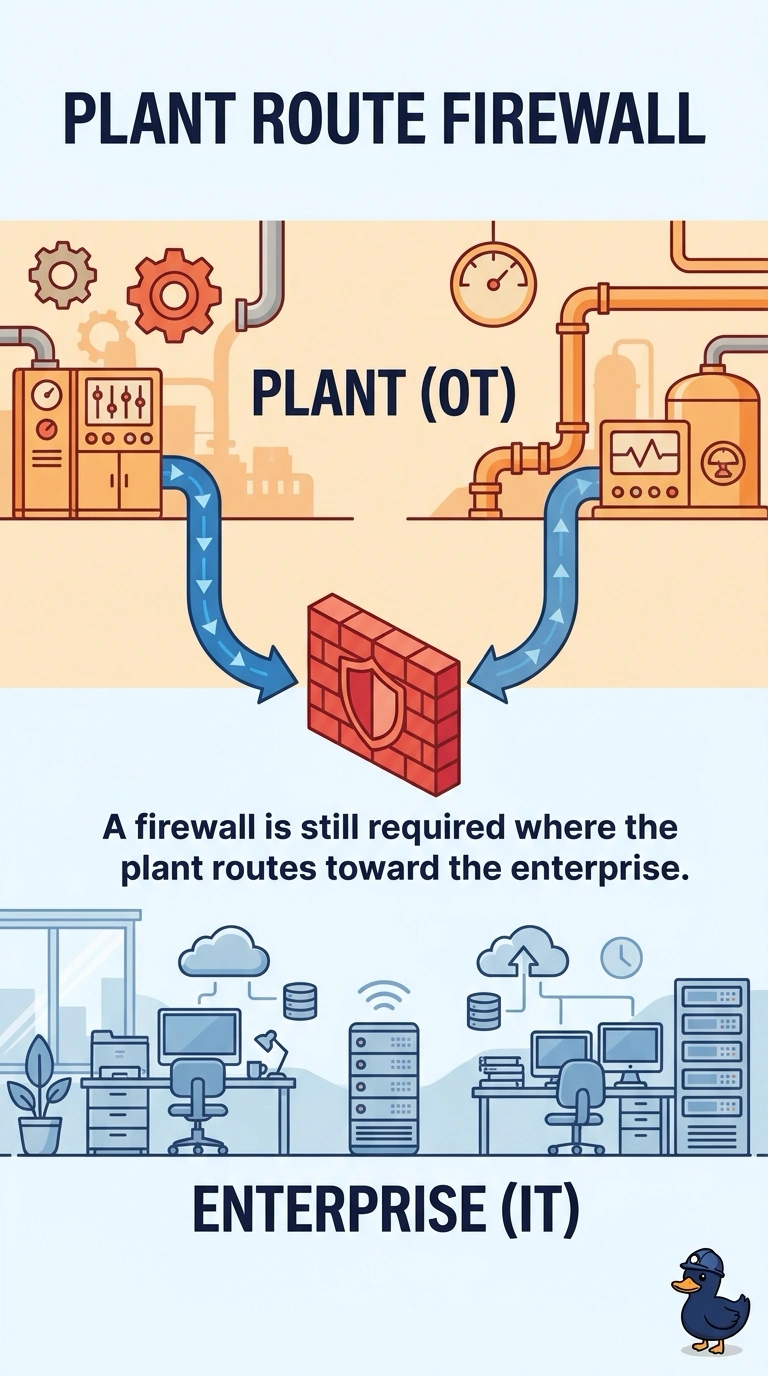
Short Explanation
Separate VLANs are separate rooms inside the plant. You still need a real door where those rooms meet the enterprise. A Layer 3 switch that routes freely is not that door, and VLAN numbers do not refuse a session.
Full Explanation
VLANs separate broadcast domains inside the beverage plant, and that part of the design can stand. Routing those VLANs straight into the enterprise on a Layer 3 switch with no firewall leaves a path where the only policy is that routing is turned on. A firewall is still required where the plant meets the enterprise, because that boundary has to permit and deny sessions rather than merely use different VLAN numbers. The claim that nothing remains, and that VLAN numbers already stop enterprise hosts, confuses an identifier with an access policy. Routing between VLANs forwards a session unless a filter refuses it. Port security on ERP servers limits which hardware addresses appear on server ports. It does not inspect or deny the plant-to-enterprise flows, so it does not replace the boundary firewall. Stretching each cell VLAN into the enterprise removes routing by making the cell and the business one broadcast domain. That is flatter, not safer. Exam caveat: the firewall controls traffic that crosses the boundary. It does not police two controllers that stay inside one cell VLAN. Those are different hops. Operational check: from an enterprise host, a connection to a cell controller that is not explicitly permitted should fail at the firewall, and the one permitted flow should succeed.