
A paper-mill utilities switch, a Cisco Industrial Ethernet switch, still accepts SNMP reads that use the community string public. Which baseline change should come first?
Select an answer to reveal the explanation.
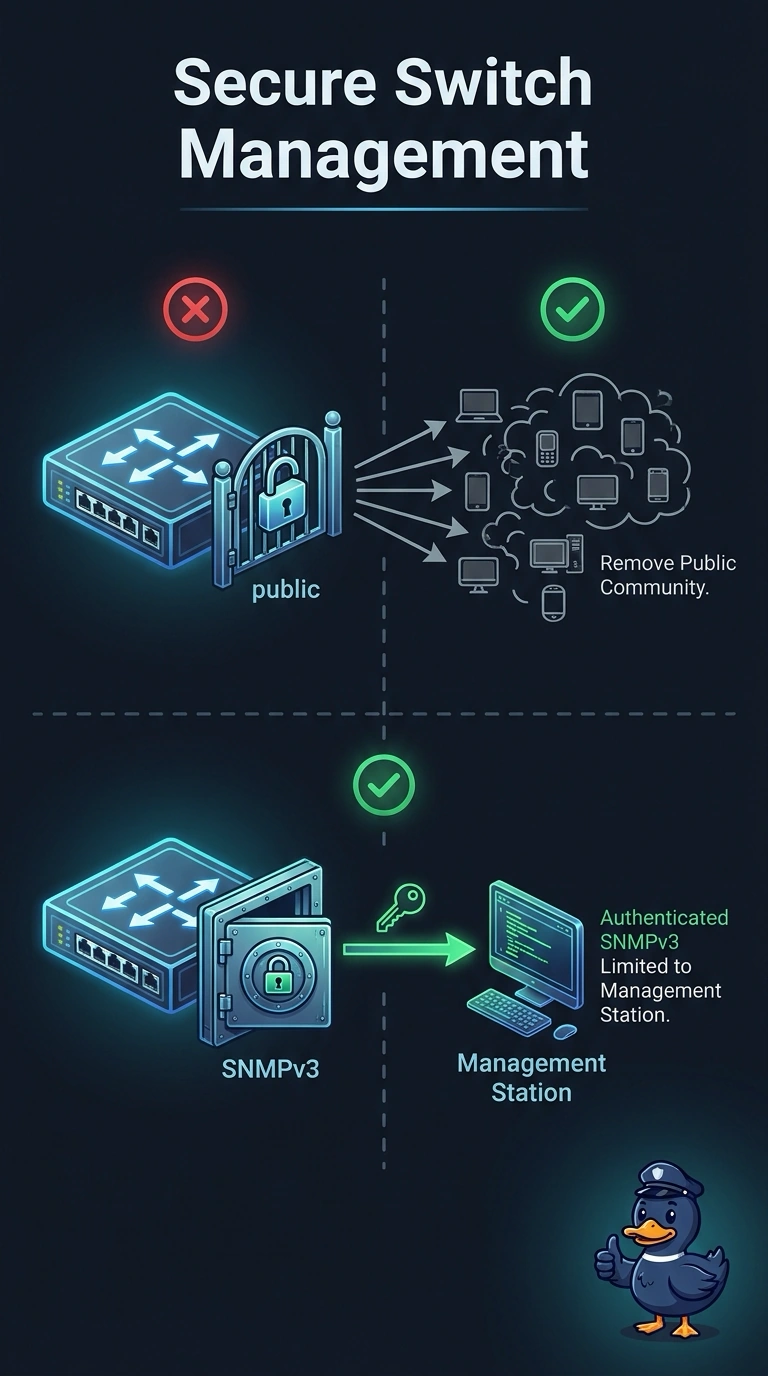
Short Explanation
You can think of the community string public as a labeled key under the doormat: remove it and use authenticated SNMPv3 limited to the management station. A banner mentioning SNMP does not secure the working community, enabling browser administration leaves it exposed, and renaming the string to private before posting it in the lobby still makes it easy to find.
Full Explanation
The SNMP community public is a well-known string. On a utilities switch that still accepts it, anyone who can reach the service can read switch data without a real identity and may learn topology that helps a later step. Remove that community and use authenticated SNMPv3 limited to the management station, so polling has an identity and a cryptographic check rather than relying on a shared word. Keeping public while adding a login banner that mentions SNMP leaves the community working; a banner does not authenticate a poll. Enabling the HTTP server for browser administration adds another management service but does not close SNMP; the baseline change needed here is to address the exposed community. Renaming the community to private and posting the new string in the lobby merely replaces one easily tried string with another and publishes it; a lobby notice does not restrict access. Exam caveat: an SNMPv3 user without authentication configured is only a partial move away from a community string. The goal is an authenticated session scoped to the management station. Practical check: verify the switch no longer lists the public community, an unauthenticated poll from a non-management host fails, and the management station can still poll using its SNMPv3 user.