
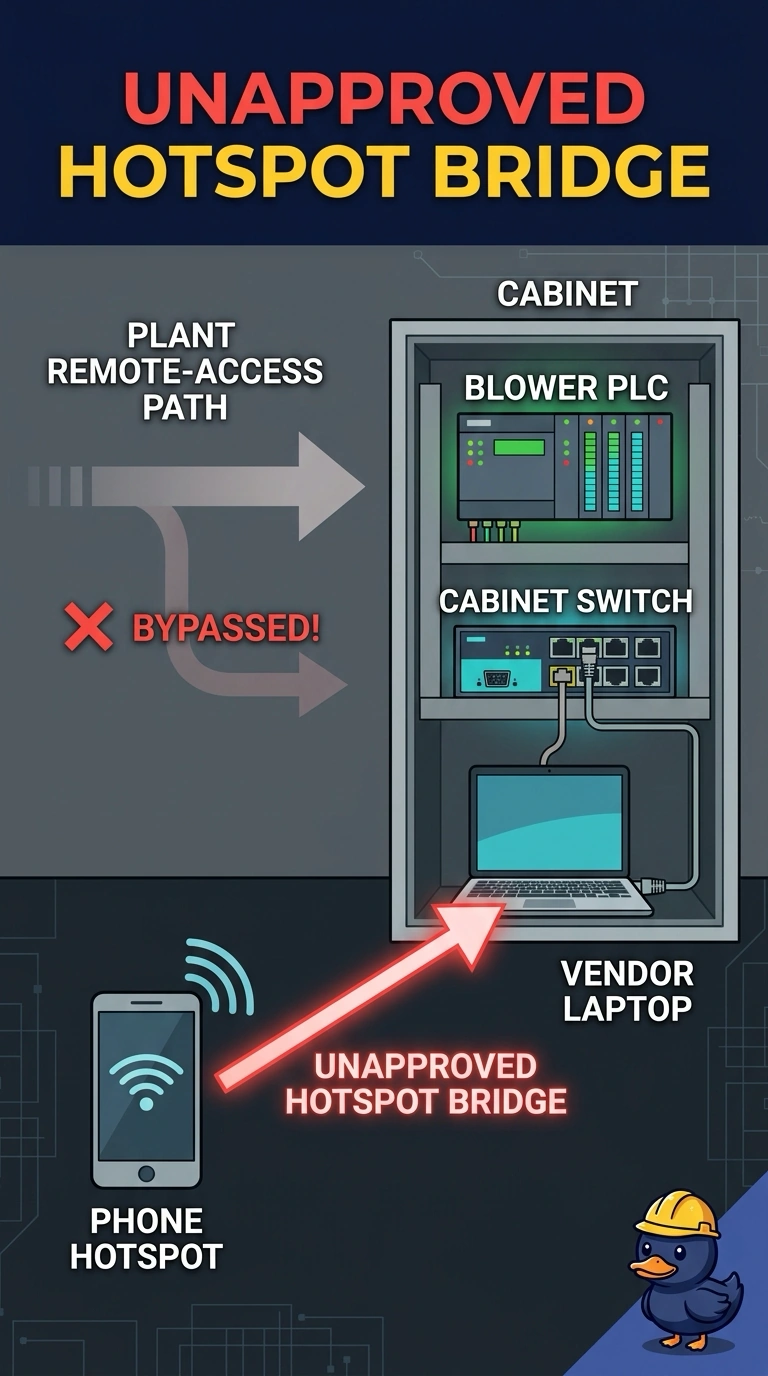
At a wastewater plant, a technician bridges a phone hotspot to a cabinet switch so a vendor laptop can reach a blower PLC without the plant remote-access path. Which problem is that?
Select an answer to reveal the explanation.
Short Explanation
You’ve spotted a bypass: the phone hotspot gives the vendor laptop a path to the blower PLC outside the plant’s remote-access design. A site survey does not remove the need to segment that network, and WirelessHART is not the phone carrying a safety trip.
Full Explanation
Bridging a phone hotspot to the cabinet switch creates a second network path into the blower PLC. The vendor laptop reaches the controller through the phone’s cellular connection instead of through the plant’s remote-access design, so the session skips the broker, approval window, and logging that path was built to provide. That unapproved bridge is the problem. A site survey measures wireless coverage and interference; it does not remove the need to segment the blower network or authorize a bridge. WirelessHART is an instrument radio used for process measurements, not a phone hotspot or the medium that should carry a blower safety trip. Office 802.1X can authenticate clients on an office LAN, but it does not describe this technician’s bridge or automatically block every device already in the cabinet. Exam caveat: a plant-owned wireless LAN, surveyed and placed on its own VLAN, is a different design from a personal phone plugged into the cabinet. Operational check: find the phone and bridge, remove them from the cabinet switch, and confirm the blower PLC no longer has a path out through that handset.