
An oil-terminal crew manages Cisco Industrial Ethernet switches only from addresses on the loading-rack VLAN. A storm on that VLAN also takes away switch management. Which design avoids that coupling?
Select an answer to reveal the explanation.
Short Explanation
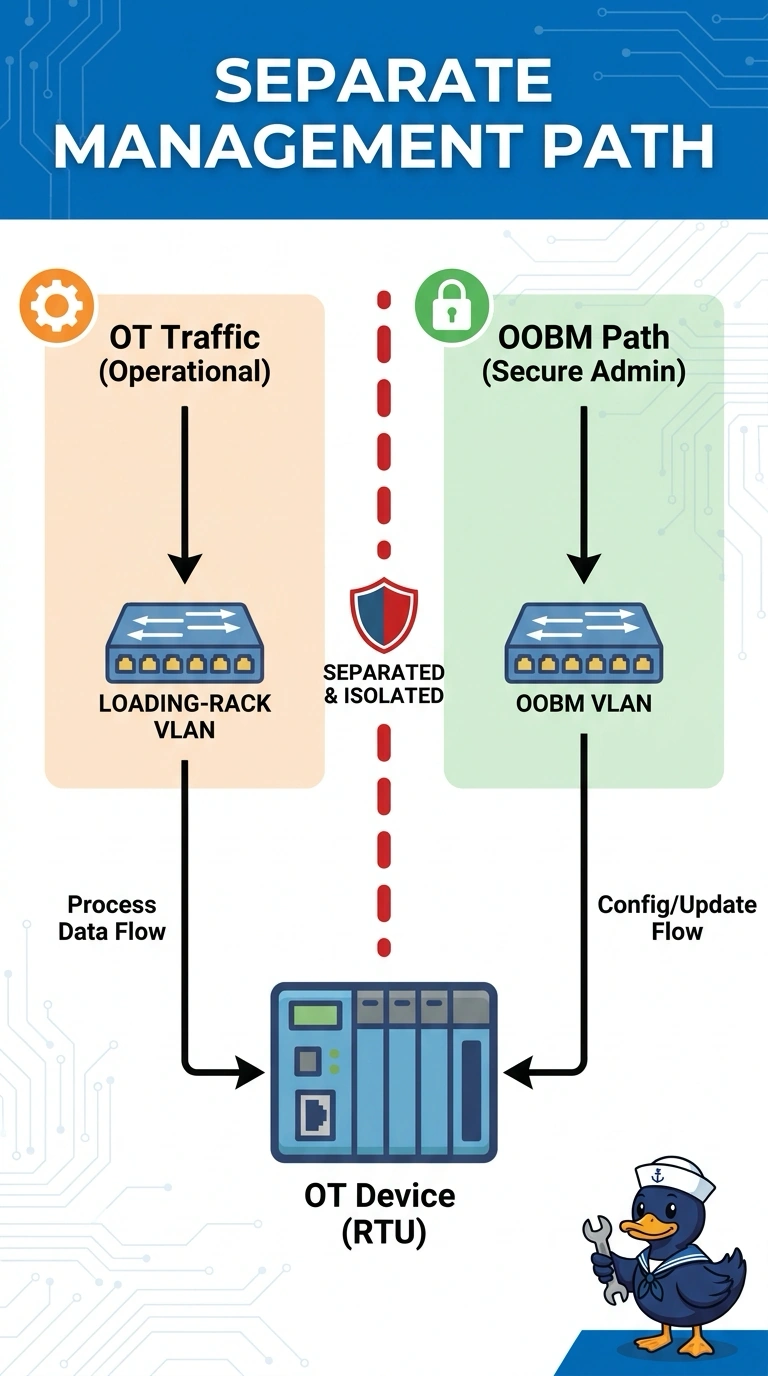
You need out-of-band management: a separate path that stays available when the loading-rack VLAN is affected. Keeping management on that VLAN means a longer enable secret in the rack binder cannot restore access during an outage. You also avoid placing switch management beside the loading PLCs or tying it to the enterprise user VLAN.
Full Explanation
Out-of-band management gives the oil-terminal switches a path that does not use the loading-rack VLAN. When a storm or loop fills that VLAN, in-band addresses fail with the cell, leaving the crew unable to reach a switch to recover it. A separate management network, accessible only from known admin stations, can still forward because its path is independent of the rack VLAN. Staying in-band and storing a longer enable secret in the printed rack binder leaves the management session on the VLAN that failed; a longer password cannot restore that path. Serving the switch web page on the loading-rack VLAN places web management beside the PLCs and preserves the same single failure domain. Moving switch management to the enterprise user VLAN ties switch control to the office laptops’ network, creating wider exposure rather than an out-of-band plant path. Exam caveat: separation alone does not establish trust. Restrict the out-of-band path to admin stations, and do not leave a second open management service on the loading-rack VLAN for convenience. Practical check: during a maintenance window, interrupt a test loading-rack path and confirm the switch still accepts SSH on the management network while a host on the loading-rack VLAN cannot open it.