
A rail crew adds only a legal warning banner to a Cisco Industrial Ethernet switch and changes nothing else. What security effect does that banner have?
Select an answer to reveal the explanation.
Short Explanation
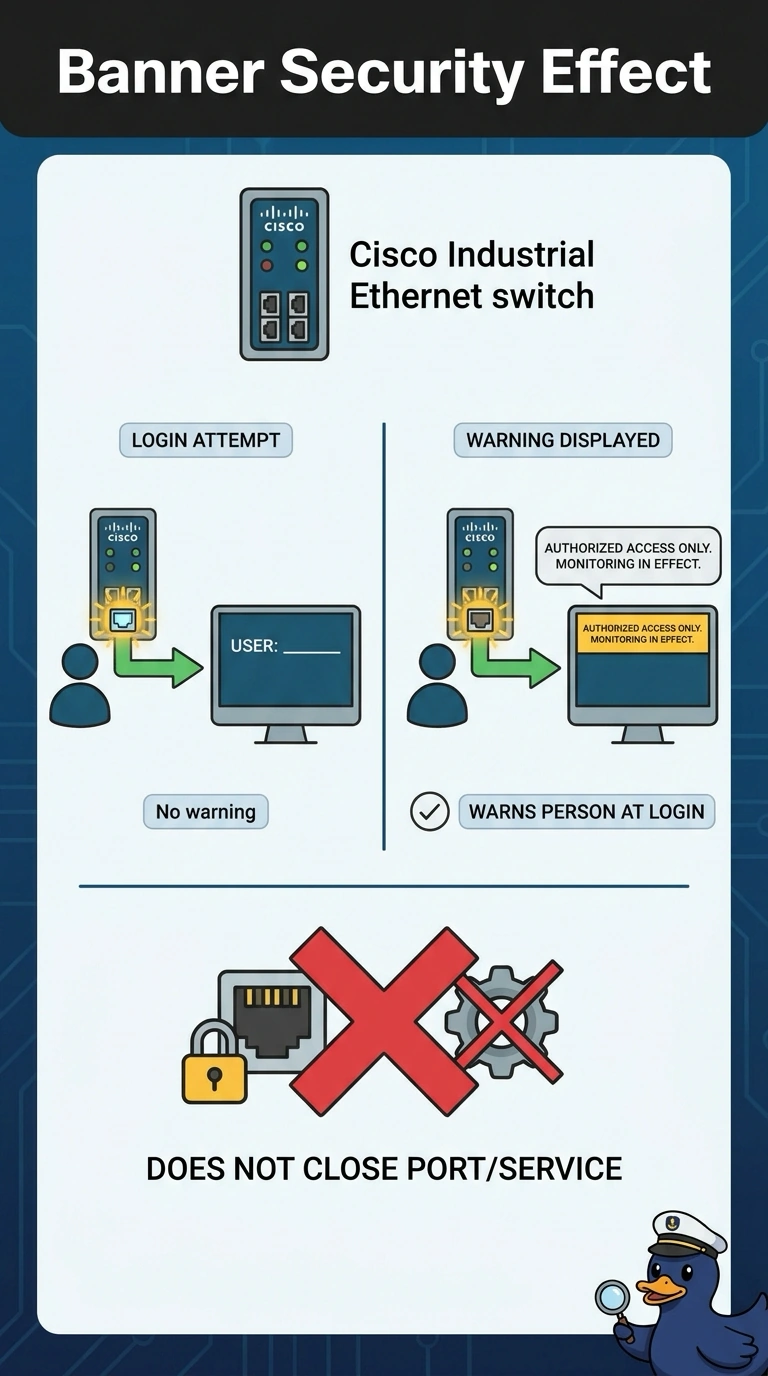
A login banner is a sign on the door, not the lock. You have warned whoever connects, and you have not closed a port or turned a service off. Treating the sign as full hardening, as a substitute for accounts, or as a switch that configures itself is how the door stays open.
Full Explanation
A login banner displays a notice when someone connects. It can say that access is monitored or that unapproved use is forbidden. It does not change the state of any port, and it does not disable a management service, so the switch stays as open as it was before the banner was saved. Full hardening would include encrypted management and unused ports that are shut. Banner text does not enter those commands, and saving the banner does not imply they ran. Unique user accounts are an authentication choice. A banner does not create them and does not remove the need for them. IP source routing and the HTTP server are separate features. They remain in their previous state until someone configures those features, and a banner has no side effect that turns them off. Exam caveat: a banner is still useful so a later review can show the user was notified. It is not the control that closes a port or a service, and this stem changed nothing else. Operational check: connect and confirm the banner appears, then check unused ports and unused management services against the baseline instead of assuming the banner set them.