
At a gas compressor station, any address can SSH to a Cisco Industrial Ethernet switch, and the switch still accepts SSH version 1. Which management change fits the baseline?
Select an answer to reveal the explanation.
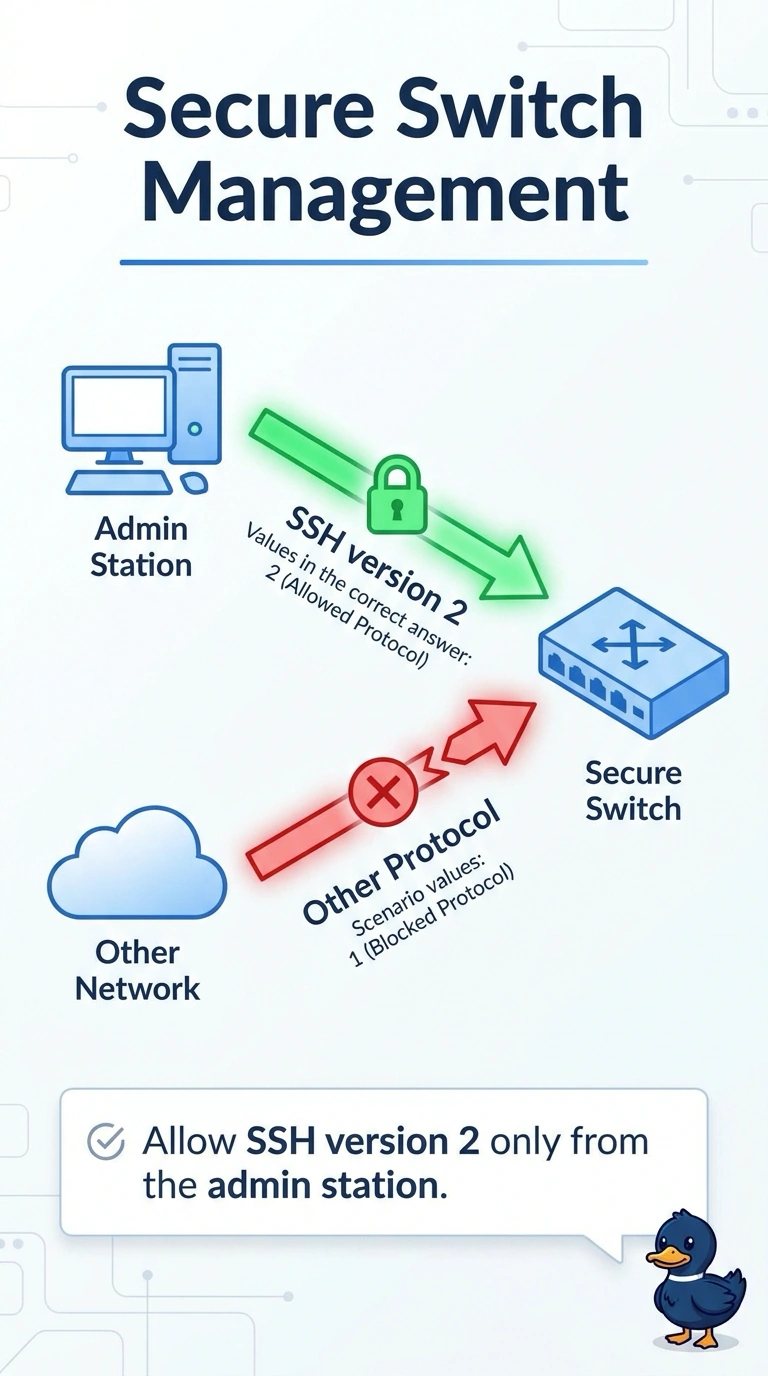
Short Explanation
The management door should know one office, not every room in the plant. You allow SSH version 2 only from the admin station, and you stop letting the PLC VLAN open a shell. A password printed in a banner is a note on the door, not a lock.
Full Explanation
Switch management on a Cisco Industrial Ethernet switch should accept SSH version 2 and should accept it only from the administration station. An access class on the VTY lines names that station, and ip ssh version 2 refuses the older protocol. Together those settings close the two gaps in the stem: SSH from any address, including the PLC VLAN, and acceptance of SSH version 1. Leaving SSH open from every VLAN and printing the enable secret in the banner gives the compressor VLAN a shell and hands the credential to anyone who can see the prompt. Moving the management address onto the PLC VLAN puts administration in the same broadcast domain as the compressors, which is the arrangement the baseline is trying to leave. Disabling SSH and keeping Telnet replaces an encrypted shell with a cleartext one and does nothing about who on that VLAN may connect. Exam caveat: the access class has to name a station that engineers can still use during an incident. Limiting sources is not the same as making the switch unreachable. Operational check: from a host on the PLC VLAN, SSH to the switch should fail, and from the admin station show ip ssh should report version 2.0.