
Every contractor tablet at a cement plant joins the maintenance wireless LAN with one pre-shared key that is posted in the workshop. Which change improves that access?
Select an answer to reveal the explanation.
Short Explanation
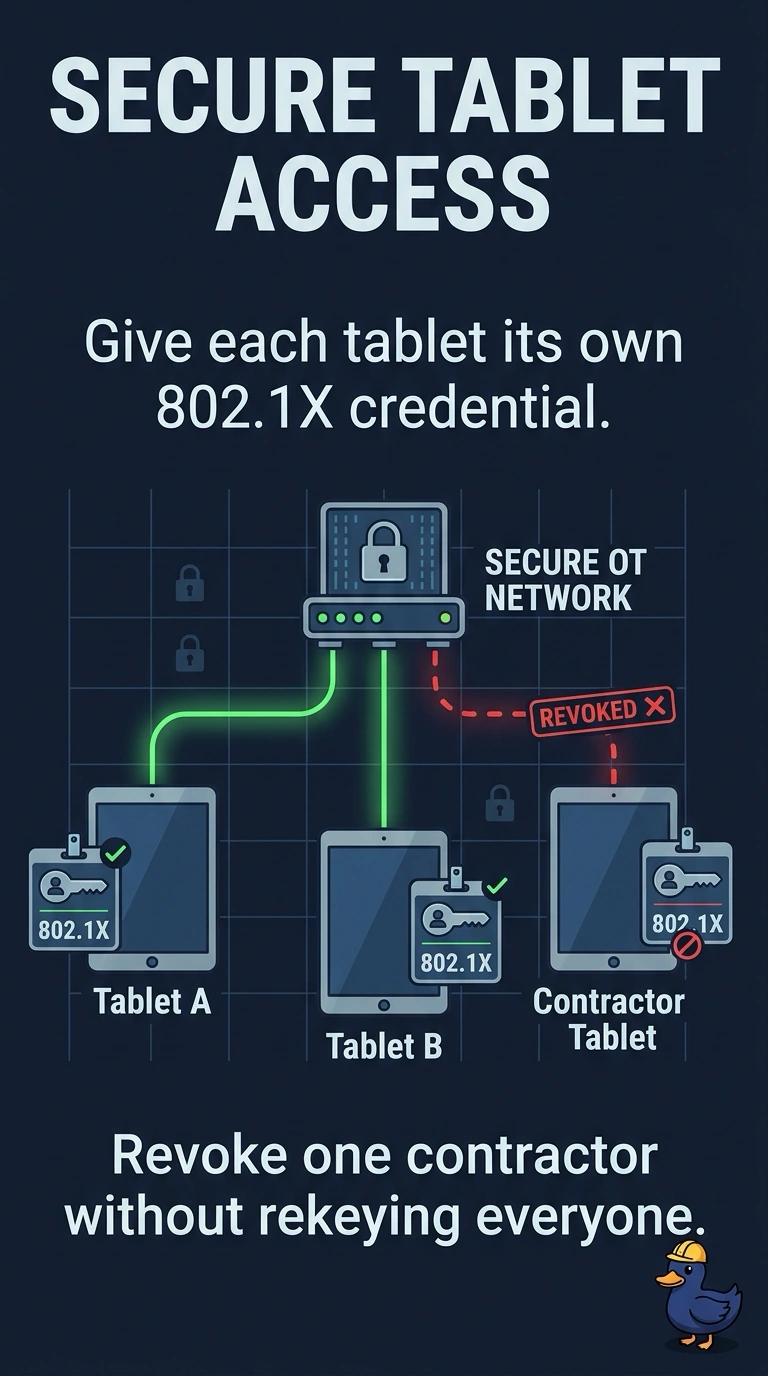
One key on the workshop wall is a key every contractor keeps, and you cannot take it back from one person without changing the lock for all of them. You put a credential on each tablet so a departure revokes that tablet. Bridging the radio into the controller VLAN makes the shared secret more dangerous, not safer.
Full Explanation
A pre-shared key is a secret every tablet holds. When it is posted in the workshop, it is not a secret at all, and removing one contractor means changing the key and touching every remaining tablet. 802.1X gives each tablet its own credential, so that tablet can be revoked in the authentication server without rekeying the fleet. Posting a larger copy of the same key spreads it further. Bridging the wireless LAN into the controller VLAN places every associated radio beside the PLCs, which is the opposite of containing contractor access. Turning authentication off because of a fence ignores that radio does not stop at the property line and that the fence does not name the tablet. Exam caveat: 802.1X helps only for clients that can run it. A sensor that cannot should stay on a separate, tightly limited segment, not on this shared key. The maintenance tablets in this stem can use per-device credentials. Operational check: disable one test tablet's credential and confirm that tablet fails while the others still associate, and confirm the wireless VLAN is not bridged into the controller VLAN.