
A trunk into an office building on a mining site allows every VLAN, including the conveyor safety VLAN. Which change fits the segmentation design?
Select an answer to reveal the explanation.
Short Explanation
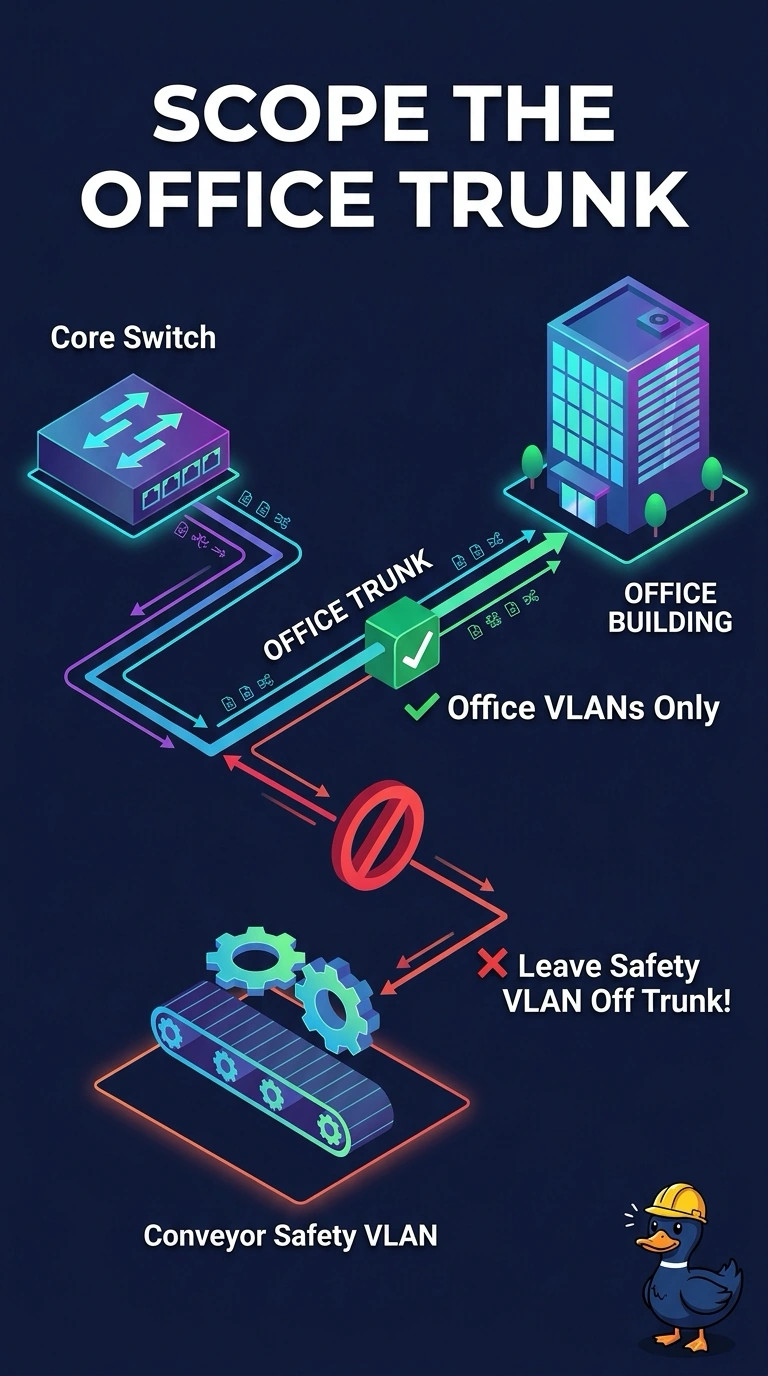
Think of the trunk as a hallway that currently opens every room in the mine, including the safety system, into the office building. You can limit it to the VLANs the office needs and keep the safety VLAN off it. Leaving every VLAN allowed, making the safety VLAN native, or connecting the office directly to it opens the wrong door wider.
Full Explanation
A trunk carries the VLANs on its allowed list. When every VLAN is allowed, the conveyor safety VLAN is present on a switch in the office building, so a mistake or compromise there can reach safety traffic. Limit the trunk to only the VLANs the office building is supposed to carry, and omit the safety VLAN; this applies least privilege at the link. Leaving every VLAN allowed so a future controller can be reached avoids a later change window, but convenience does not justify exposing the safety network to the office. Making the safety VLAN native does not isolate it: untagged frames on the trunk are placed into that VLAN, so this setting does not keep office traffic out of the safety domain. Disabling the trunk and connecting the office switch to the safety VLAN with an access port is worse for segmentation, because it puts office equipment directly in the safety broadcast domain. Exam caveat: simply disabling trunking is not isolation if the access port still assigns the office switch to the safety VLAN, and a list that still includes the safety VLAN also fails the design. Practical check: run “show interfaces trunk” on the link to verify that the intended office VLANs are listed and the safety VLAN is absent, then confirm that an office test host cannot see safety traffic.