
A technician finds an unknown wireless access point patched into a live switch port inside a bottling-cell cabinet. Which risk does that access point create?
Select an answer to reveal the explanation.
Short Explanation
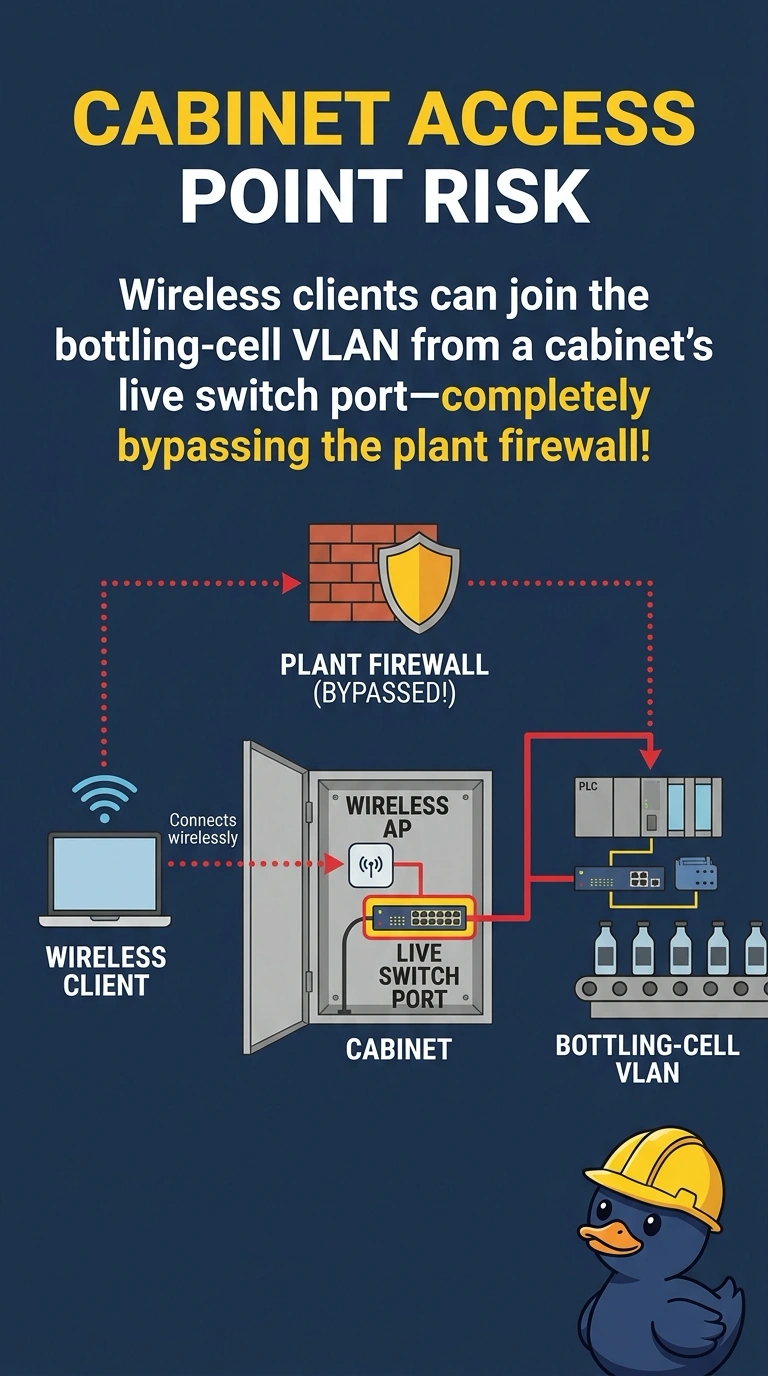
An unknown access point in the bottling cabinet is a side door cut into the cell. You have opened a radio path onto that VLAN that never passes the plant firewall. A channel survey or a closed cabinet door does not put the wall back.
Full Explanation
An access point patched into a live bottling-cell switch port bridges wireless clients onto that port's VLAN. Those clients join the cell without crossing the plant firewall, which is the risk the unknown device creates. An access point does not encrypt the PLC program, and it does not force the HMI to be rekeyed. That story describes a different control than a radio bridged into the cabinet. A site survey can recommend channels for a planned wireless design. By itself it does not remove a rogue access point or close the path the patch cord created. Mounting the device inside a cabinet does not keep clients on the office LAN. Once the cord lands in the cell port, the radio is attached to the cell VLAN regardless of which room the sheet metal is in. Exam caveat: a sanctioned industrial access point, on an approved SSID and VLAN, is a designed path. This stem is an unknown device on a live cell port, and the risk stands until that port no longer bridges it. Operational check: trace the access point MAC to the switch port and confirm that port sits in the bottling-cell VLAN, which is how those wireless clients skip the plant firewall.