
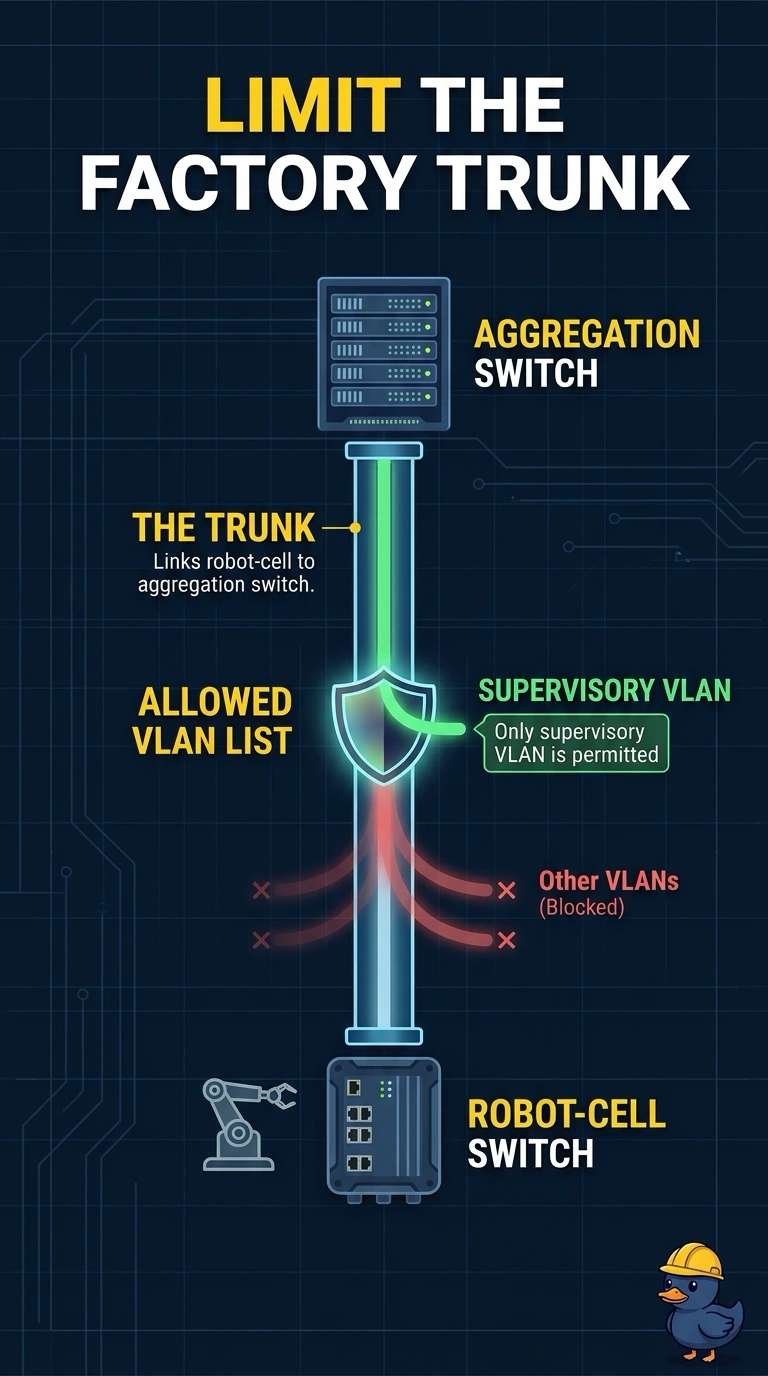
A factory trunk links a robot-cell switch to the aggregation switch, and only the cell supervisory VLAN must cross it. Which design matches that goal?
Select an answer to reveal the explanation.
Short Explanation
A trunk is a hallway between buildings, and you do not issue a key to every floor. You permit only the supervisory VLAN this robot cell must extend. Carrying every VLAN, or dropping untagged frames into the PLC VLAN, opens rooms the trunk was not meant to serve.
Full Explanation
A trunk allowed-VLAN list is how Cisco IOS limits which VLANs actually cross a link. The goal is that only the robot cell's supervisory VLAN extends to the aggregation switch, so the list permits that VLAN and not the rest of the plant. A trunk that forwards every VLAN carries broadcast domains the cell does not need on that link, including VLANs that have nothing to do with this robot. Setting the native VLAN to the robot PLC VLAN dumps untagged frames into the control network, which is a different and worse choice than limiting the tagged list. One flat VLAN from the controllers through the core into the ERP servers removes the boundary entirely so that no trunk filter is left to enforce. Exam caveat: the allowed list still has to contain the supervisory VLAN the cell genuinely must extend. Pruning that VLAN by mistake darkens the far side of the link even though the security intent was right. The allowed list is a permit of named VLANs on this trunk, and a VLAN left off that list does not cross the link. Operational check: on the trunk, the allowed list should show the supervisory VLAN and should not show the PLC VLAN or the ERP VLAN as permitted.