
A building-automation Cisco switch still answers SNMP using the community string public. Which baseline change addresses that exposure?
Select an answer to reveal the explanation.
Short Explanation
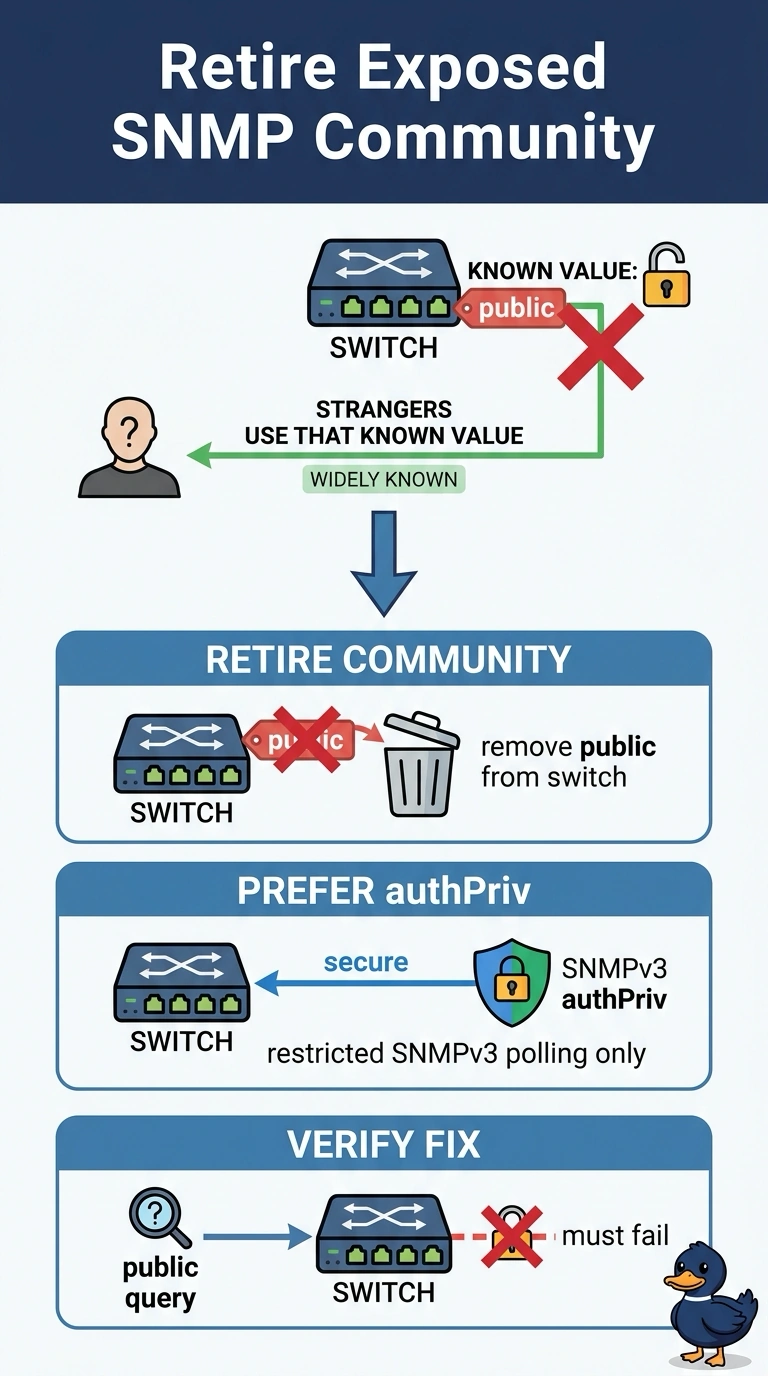
public is a widely known community value, not a universal Cisco factory configuration. A community grants only its configured read-only or read-write access. Retire the exposed community and prefer restricted SNMPv3 authPriv so you are not relying on a value strangers already know.
Full Explanation
public is a widely known community value, not a universal Cisco factory configuration. A building-automation switch that still answers with it lets anyone who can reach the service use that known value with a guess that requires no secret. A community grants only its configured read-only or read-write access. Retire the exposed community and prefer restricted SNMPv3 authPriv. The baseline change removes the known value so polling uses authentication with privacy. Printing public in the login banner keeps the exposed value and advertises it to anyone who can see the prompt. Turning off IP routing does not remove an SNMP community on the switch, and it can break management or inter-VLAN forwarding the building still needs, while the known value remains. Opening the switch web page on the controller VLAN and dropping SNMP trades one open management service for another. Unsigned browsing on the controller VLAN is not a hardening of the SNMP exposure. Exam caveat: replacing the value is incomplete if the new community is shared with everyone and posted on the same banner. The management station still needs a credential that is not the published value. Operational check: an SNMP query that uses public should fail, and the management station should still be able to poll with the replacement credential.