
A power-plant historian export crosses a data diode. A power fault hits the diode, and an engineer fears it will become a two-way cable. Which failure behavior should the design require?
Select an answer to reveal the explanation.
Short Explanation
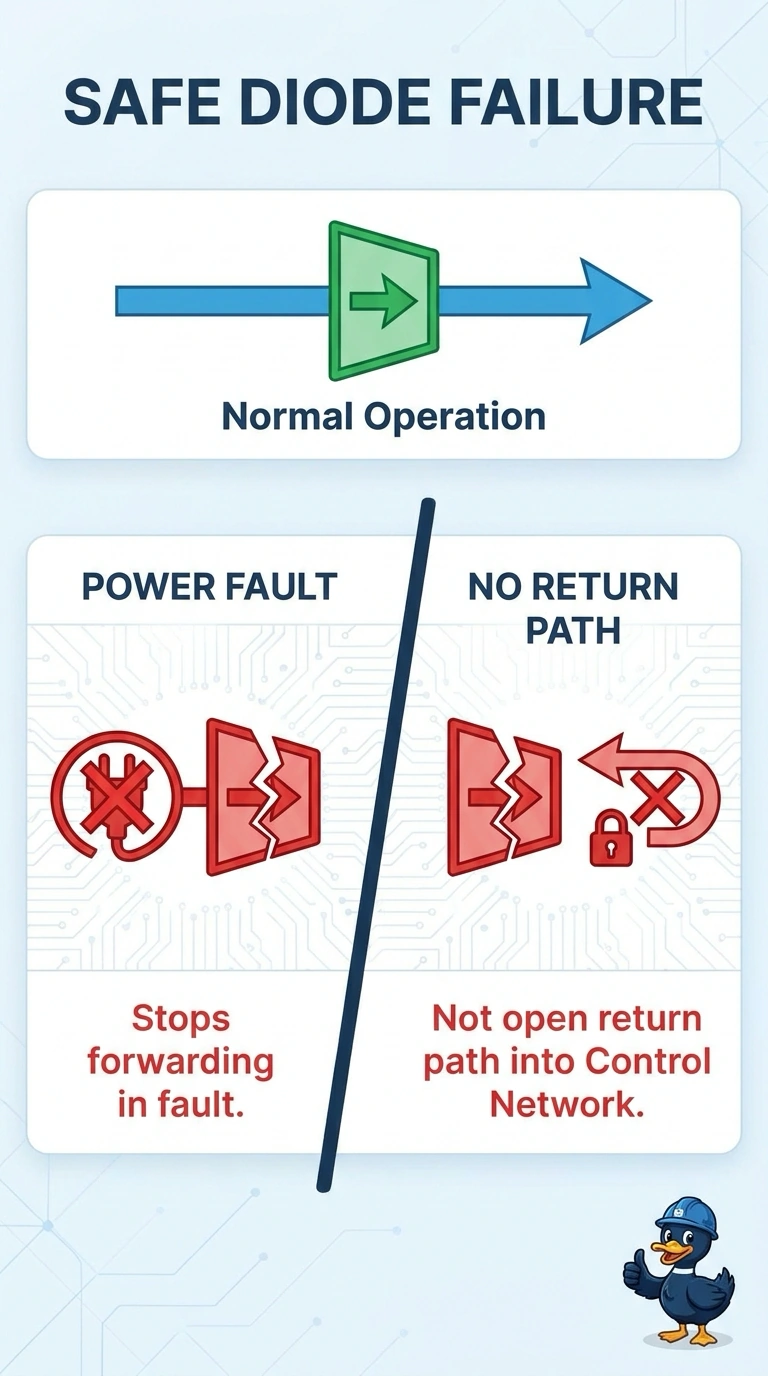
A one-way turnstile that loses power should jam shut, not swing open into a two-way gate. You should require the historian diode to stop forwarding in a fault and never open a path back into the control network. Hoping the fault becomes a handy cable is the trap.
Full Explanation
A data diode is one-way hardware. Its security value is that traffic cannot come back into the control network, including when the device is unhealthy. The failure behavior the design should require is fail closed: forwarding stops, and the fault does not open a return path while power is lost. The historian export may pause. That pause is acceptable. A reverse path is not. Failing open into a normal cable would keep the export and would also destroy the one-way property the plant installed the diode to get. A power fault is not an opportunity to turn the diode into an interactive remote-desktop path to the HMI. Remote desktop needs replies, and a diode that started carrying them would no longer be a diode. A SPAN session copies frames for a sensor. It does not define the diode failure mode, and aiming a SPAN at the box does not stop a failed device from becoming bidirectional. Exam caveat: fail closed means the export stops during the fault, so the historian copy can go stale until the diode is restored. Plan for that gap. Do not fill it by letting the diode pass traffic both ways. Operational check: during a controlled power test in a window, confirm no session can be opened from the historian side back into the control network.