
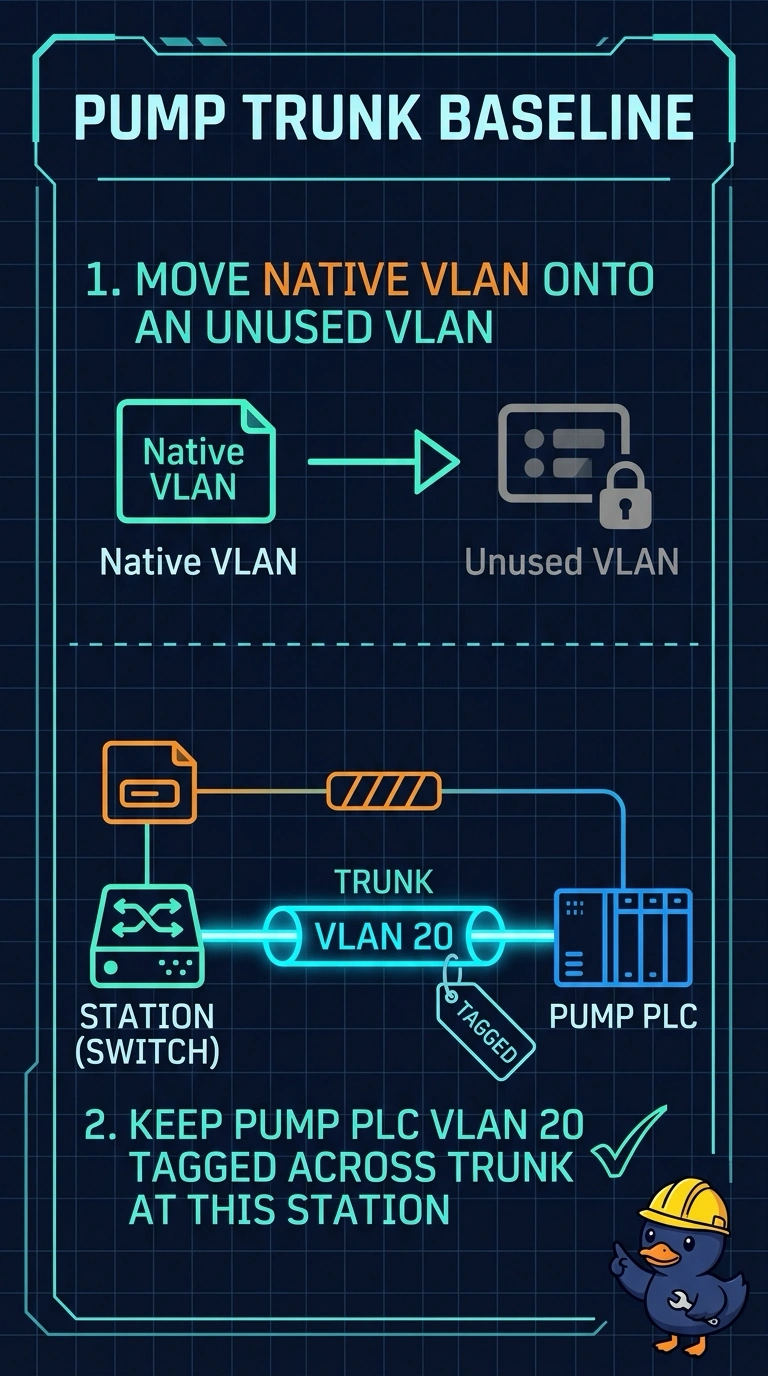
A pipeline pump-station trunk uses VLAN 20 for PLC traffic and also uses VLAN 20 as the native VLAN. Which baseline change is sound?
Select an answer to reveal the explanation.
Short Explanation
The native VLAN is the unnamed hallway on a trunk, and you do not want the pump traffic standing in it. Keep the PLC VLAN tagged and move the native VLAN to an unused number. A flat network or port security on the trunk does not fix the tag.
Full Explanation
On an 802.1Q trunk the native VLAN is the VLAN carried without a tag. When that VLAN is also the pump PLC VLAN, untagged frames on the trunk are treated as control traffic, and the cell VLAN is mixed with whatever else arrives untagged. The sound baseline moves the native VLAN to an unused VLAN and keeps VLAN 20 tagged so PLC frames are explicit on the trunk. Leaving VLAN 20 native preserves the condition the baseline is meant to remove. It saves a tag and leaves control traffic in the untagged lane. Collapsing the trunk into one VLAN from the pumps into the enterprise core removes segmentation entirely. The native-VLAN problem disappears only because every boundary disappears with it. Port security can also operate on supported static trunks, but a MAC limit does not change the native VLAN or replace VLAN design. Exam caveat: move the native VLAN in a maintenance window. A live change can drop untagged frames that were using the old native VLAN, so confirm the unused VLAN is not already the pump VLAN. Operational check: on the trunk, the allowed PLC VLAN shows as tagged and the native VLAN is an unused id that does not contain the pump controllers.