
A contractor plugs a consumer access point into a live cabinet port on a container-terminal crane cell so a tablet can join. Which risk does that create?
Select an answer to reveal the explanation.
Short Explanation
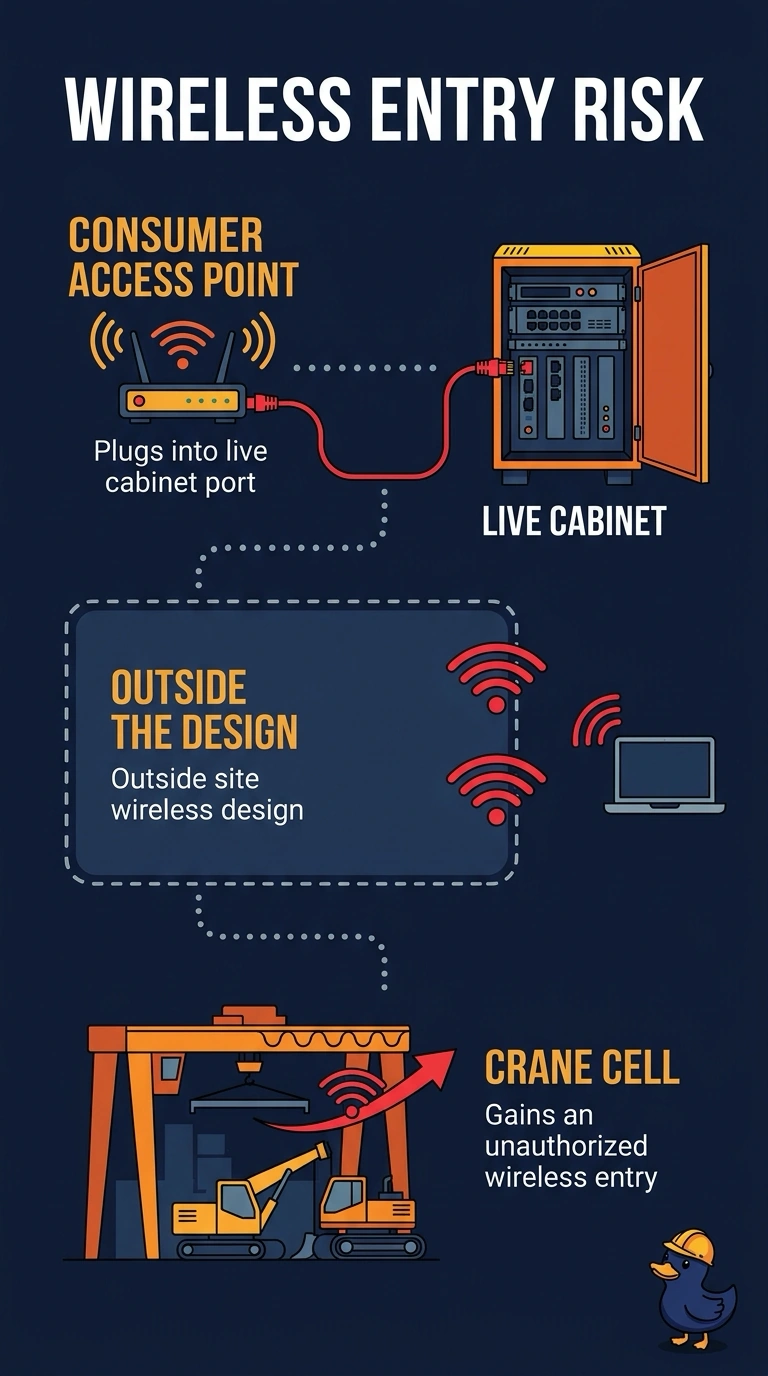
A consumer access point in a crane cabinet is a side door cut into the wall. You’ve created an unauthorized wireless entry into the cell, outside the site wireless design. A strong survey signal doesn’t make that device the cell standard, and it doesn’t make the connection WirelessHART or guarantee a guest VLAN.
Full Explanation
The cabinet port is a live port on the crane cell. A consumer access point plugged into it lets the tablet—and anyone else who can join its radio—onto whatever VLAN that port carries. That creates an unauthorized wireless entry outside the terminal’s wireless design, authentication, and placement. A strong signal recorded in a site survey describes coverage; it does not make an unapproved consumer device the cell standard, and plugging it in is not a design review. The access point also does not create a WirelessHART network: WirelessHART is an instrument network, and this consumer device is not an approved medium for crane trip signals. Nor does a cabinet port automatically bridge wireless clients only to a guest VLAN. Clients land on the access VLAN configured for that port, which in a crane cabinet may be the cell unless a different port has been deliberately configured. Exam caveat: a planned industrial access point, surveyed and connected to a dedicated VLAN, is a different design from a consumer device plugged into a live cell port. Practical check: identify the switch port and access point MAC address, confirm the device is absent from the approved wireless inventory, and remove it from the crane VLAN.