
A Cisco IE switch in a paint cell is still offering BOOTP addresses on the PLC VLAN. Controllers are supposed to use fixed addresses. Which hardening step fits?
Select an answer to reveal the explanation.
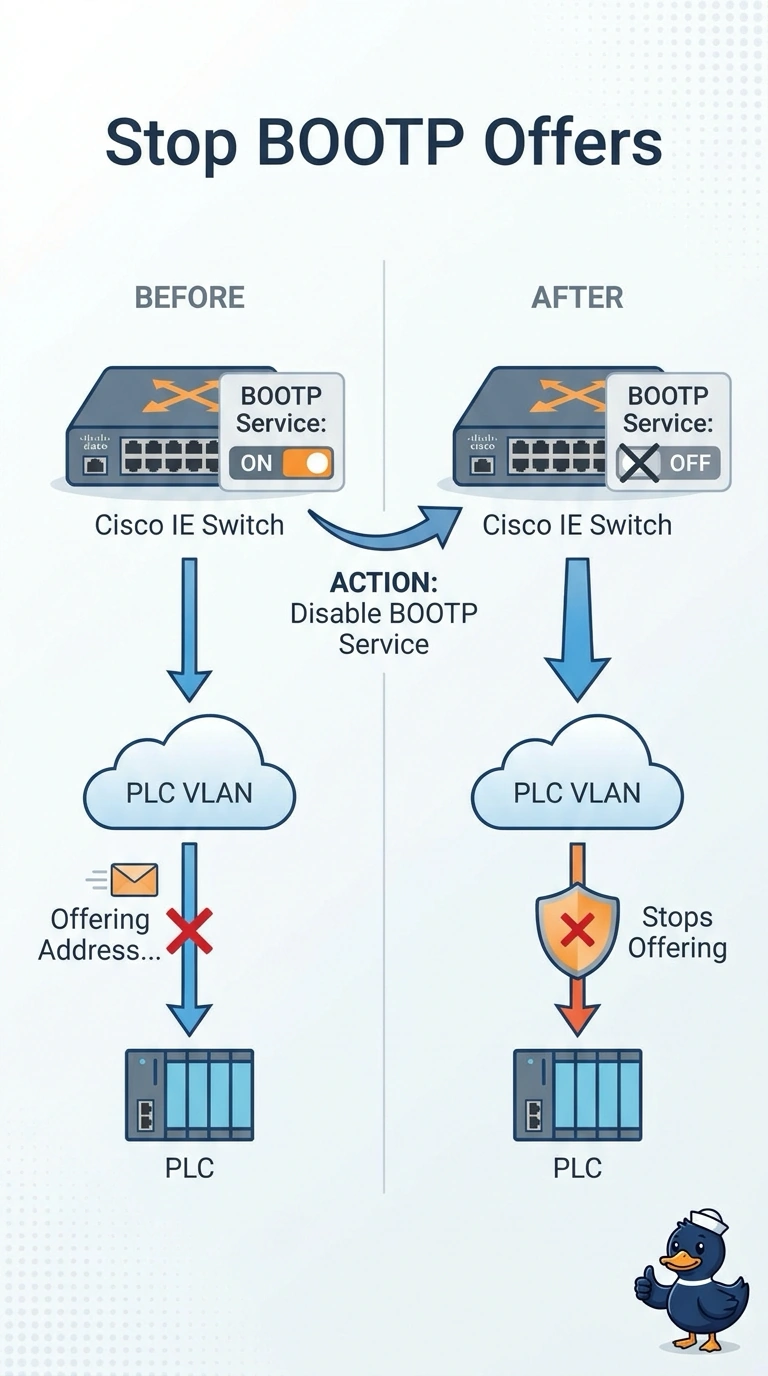
Short Explanation
You keep the PLCs on the fixed addresses operations already set by disabling BOOTP on the cell switch. That hardening step stops unexpected address offers on the PLC VLAN; treating them as a convenience can let an unplanned device join.
Full Explanation
BOOTP is an older bootstrap service, and the controllers in this paint cell are meant to use fixed addresses rather than depend on dynamic offers. Disabling the BOOTP service on the cell switch is the fitting hardening step: it stops the switch from offering addresses on the PLC VLAN while the PLCs retain their configured addresses. Leaving BOOTP on for newly arriving devices permits an unplanned device to obtain an address and appear on the control VLAN. Moving BOOTP to the safety network does not solve the underlying issue; it still introduces dynamic addressing where controlled addressing is expected. Pointing BOOTP at the enterprise DHCP scope brings office addressing into the cell and continues offers there. One caveat is that, on IOS, no ip bootp server disables the BOOTP service, but if the IOS DHCP server is enabled, it does not by itself close UDP 67; ip dhcp bootp ignore rejects BOOTP while retaining DHCP. As a practical check, test from a client on the PLC VLAN and verify that it receives no BOOTP offer, while the PLCs still respond at their fixed addresses. Record before-and-after evidence, including the interface or account changed, the time, and the approver; during a live batch, avoid an unplanned outage.