
A factory created a VLAN for each production cell, then removed the firewall between the cells and the enterprise, arguing the VLANs are enough. Routes from the enterprise still lead toward the cell switches. Which design corrects that?
Select an answer to reveal the explanation.
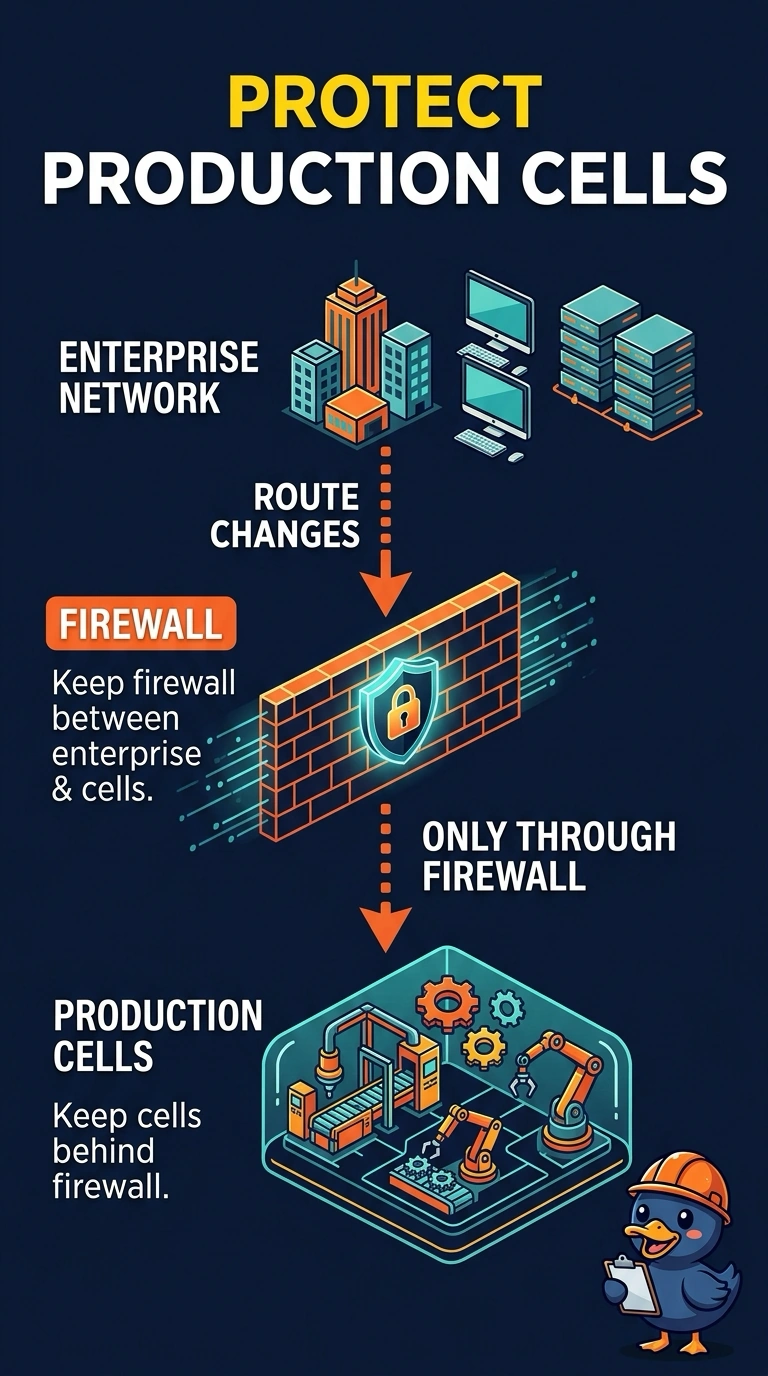
Short Explanation
You can think of VLANs as rooms inside the factory, not the guardhouse on the road to the enterprise. Keep a firewall where traffic changes levels, even when every cell has its own VLAN. Removing that boundary because the rooms have numbers is the trap.
Full Explanation
VLANs separate broadcast domains inside the factory, but they do not inspect or authorize traffic when routes lead from the enterprise toward the cell switches. Keeping a firewall between the enterprise and the cells, and routing level changes only through it, restores a controlled boundary. Stretching each cell VLAN into the enterprise removes separation and places business hosts at Layer 2 with PLCs, defeating the boundary. Making the cell control VLAN the native VLAN puts untagged frames into the control network; that is a trunk configuration mistake, not a replacement for a firewall. Port security limits which MAC addresses can use a switch port. Applying it to ERP servers does not inspect routed enterprise-to-cell flows or enforce policy at the boundary. Exam caveat: restoring the firewall does not mean collapsing the cell VLANs into one plantwide network behind it; the VLANs should still separate cells from one another. Practical check: from an enterprise host, verify that a session toward a cell PLC is evaluated by the firewall and denied unless a specific rule permits it, and confirm that cell VLANs are not trunked into the enterprise core.