
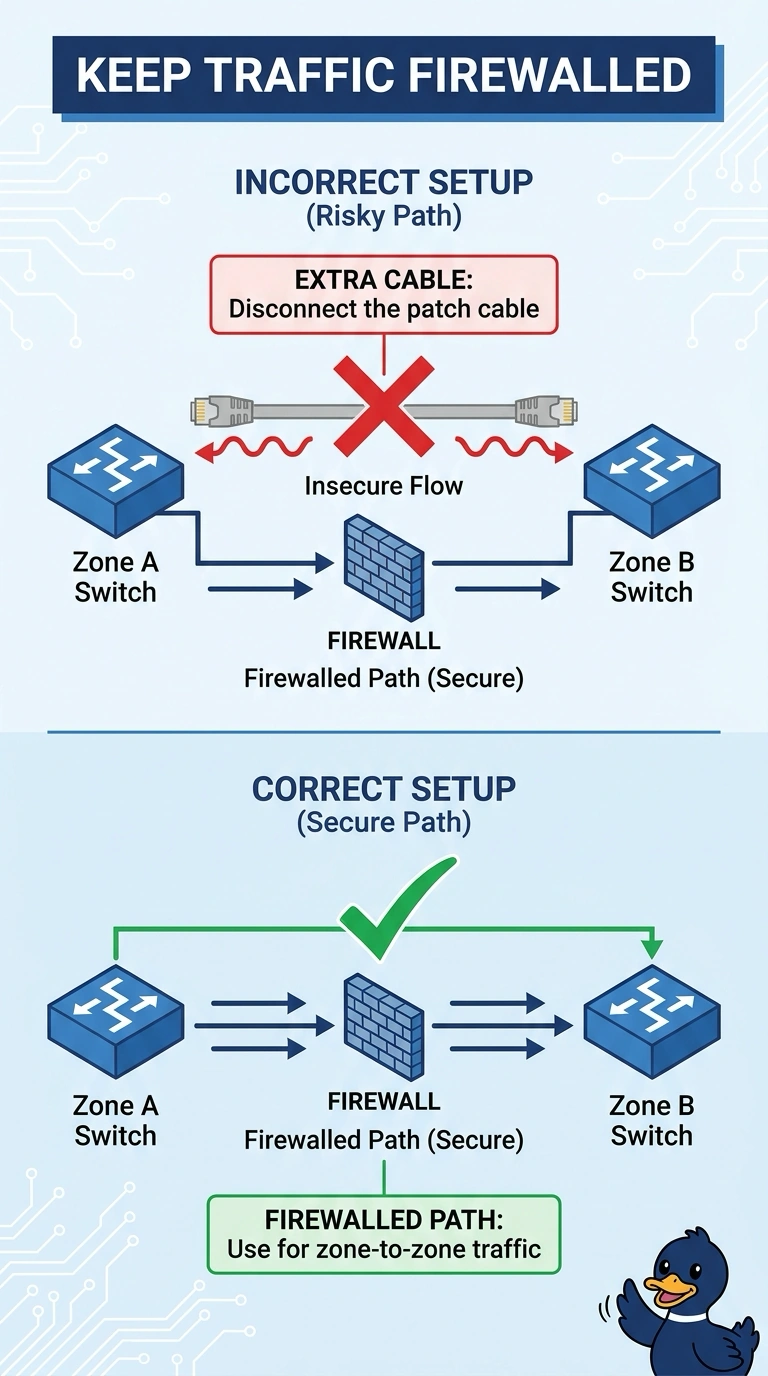
A sawmill has a firewall between the control zone and the enterprise zone. A tech also finds a patch cable that ties the two switches together around that firewall. Which action fits?
Select an answer to reveal the explanation.
Short Explanation
A side door does not become a policy just because it is convenient. You pull the cable that skips the firewall and leave zone-to-zone traffic on the path that has rules. The trap is calling a bypass a backup conduit.
Full Explanation
A conduit is the controlled path between zones. The firewall is that path here. A patch cable between the switches forwards traffic with no rule and no log, so it undoes the zone design. Leaving it in place means the firewall only sees the flows that happen to use it. Moving the firewall down into a PLC-to-drive loop would put a filter in a cyclic control path and would still leave the bypass. A SPAN session copies frames; aiming it at the cable does not make the cable enforce anything. The caveat is that you confirm the cable is not the only path a required historian query uses before you pull it, and you add that query to the firewall if it is legitimate. The check is the switch MAC and neighbor tables after the pull: the two zones should meet only through the firewall. Put the before-and-after evidence in the work order, including the interface or account you changed, the time, and the person who approved it. On the next shift, confirm the original symptom is gone and that the change did not open a second path while closing the first. If the process is still inside a live batch, leave the controller running and finish only the part of this work that does not restart it. That sequence keeps a correct fix from turning into an unplanned outage.