
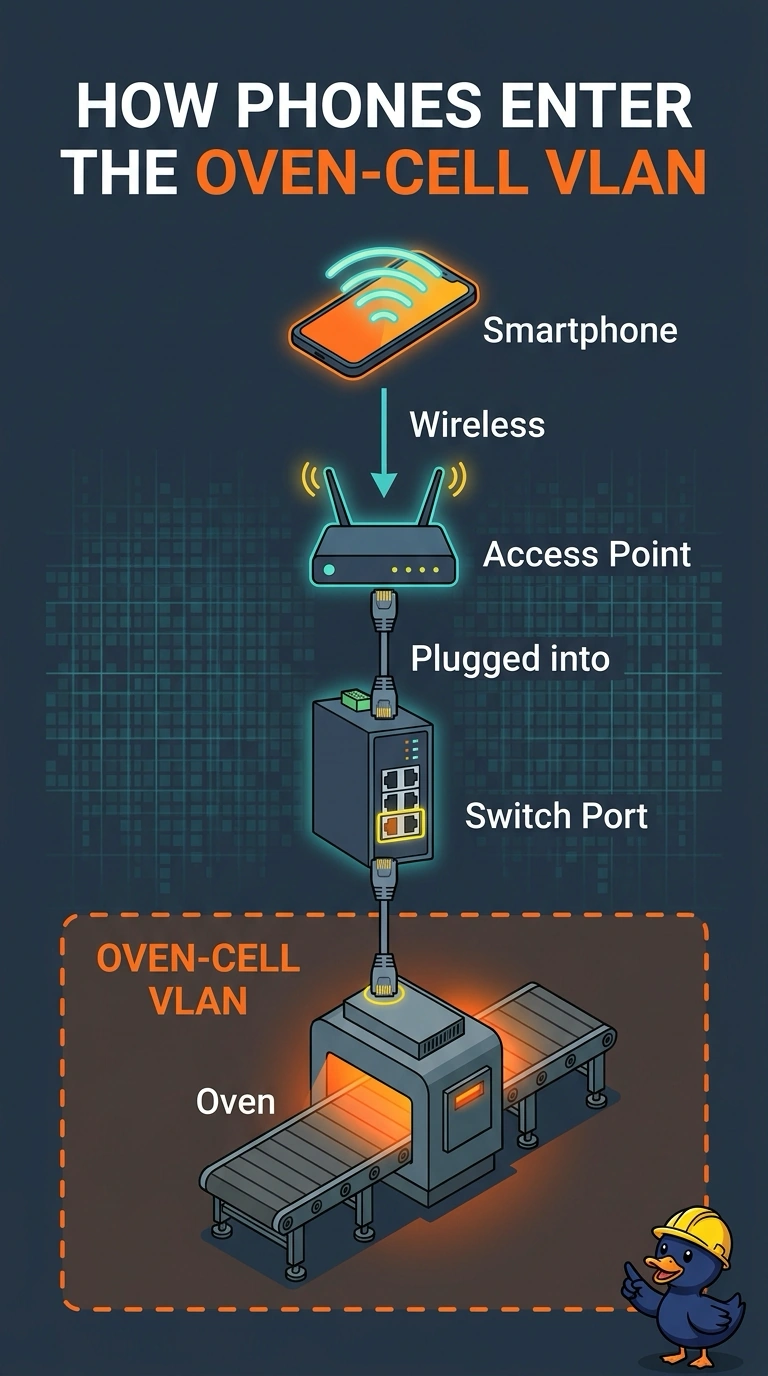
A contractor plugged a small access point into a live access port inside a bakery oven cabinet so phones could join the network. That port is in the oven-cell VLAN. Which risk is this?
Select an answer to reveal the explanation.
Short Explanation
That access point in the oven cabinet is a side door cut into the cell wall. You just offered unknown phones a path onto the oven VLAN. The trap is calling the radio a site survey or a field instrument because it has an antenna.
Full Explanation
An access point bridged on an access port extends that port's VLAN onto the radio. Phones that associate can send traffic into the oven-cell VLAN, which is a rogue wireless entry into the control network the contractor was not given. A site survey measures coverage and interference for a wireless design someone planned. It does not authorize an unplanned radio, and it does not replace segmentation of the oven cell. WirelessHART is a field-instrument protocol for process measurements. A small access point plugged into Ethernet so phones can join is not that instrument mesh and is not oven-temperature reporting. 802.1X authenticates a supplicant before the port grants the VLAN. An access point appearing in the cabinet does not prove authentication succeeded. If the port accepts any link, the radio is on the cell VLAN with no such check. Exam caveat: a designed instrument radio on its own segment is a different project from this stem. The stem is phones on an unplanned access point in the oven VLAN. Operational check: find the switch port, shut it or remove the access point, and confirm no unknown wireless client remains in the oven-cell VLAN.