
A bottling-line designer wants a stateful firewall between the filler PLC and its variable-speed drives so every cyclic frame can be inspected. Which placement should be chosen?
Select an answer to reveal the explanation.
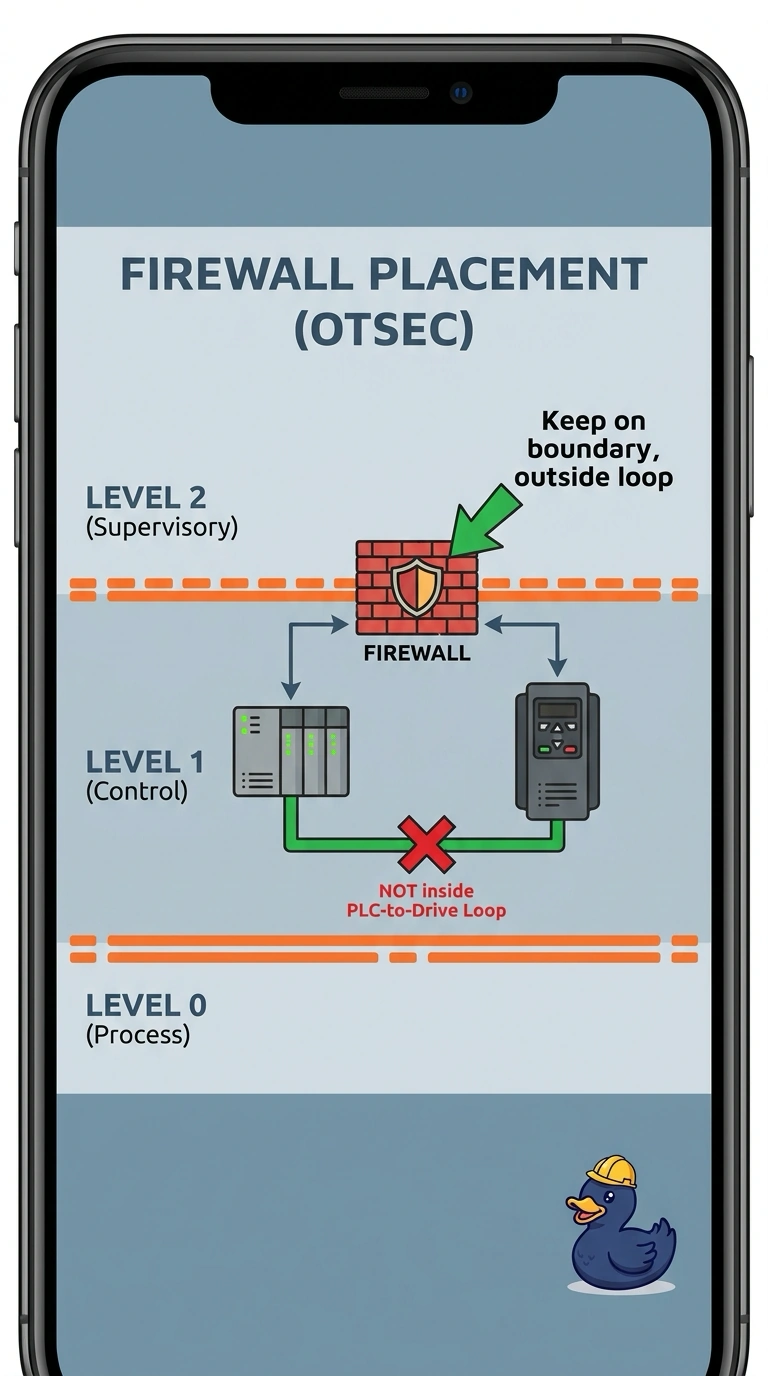
Short Explanation
You see the filler and its drives mid-sentence in a local conversation that a guard shack will only interrupt, and you know inspection inside the loop will not make motion safer. For this existing control loop, retain the validated cyclic path and apply the boundary firewall. Any proposed inline firewall needs timing, availability and safety validation; placement is not determined solely by Purdue level.
Full Explanation
Cyclic traffic between a filler PLC and its drives is a local control loop. It is time sensitive, and the drives have to answer. A stateful firewall spliced into that loop inspects a conversation the line was built to keep local, and it can delay or drop the frames that keep the filler moving. The placement that fits is a firewall on a boundary between levels, where traffic is meant to be policy controlled, not between the PLC and the drives. Inspection does not make cyclic motion more deterministic. Adding a stateful device in the middle adds a component the loop has to survive. A data diode has no return path. Drives that cannot reply cannot close a control loop, so a diode is the wrong device in this spot as well as the wrong place. Inspecting only enterprise PCs and leaving every plant path open abandons segmentation where the levels meet. That is not a substitute for putting the firewall on the boundary. Exam caveat: the cell uplink toward the next level is that boundary. It is not a second firewall parked between the PLC and the drives. Operational check: the drawing should show the PLC and drives on the same cell segment with no firewall between them, and the firewall on the path that leaves the cell.