
A food plant's boundary rule was supposed to let only the historian query the batch-cell PLCs. The live ACL permits the entire enterprise subnet instead. Which change matches that design?
Select an answer to reveal the explanation.
Short Explanation
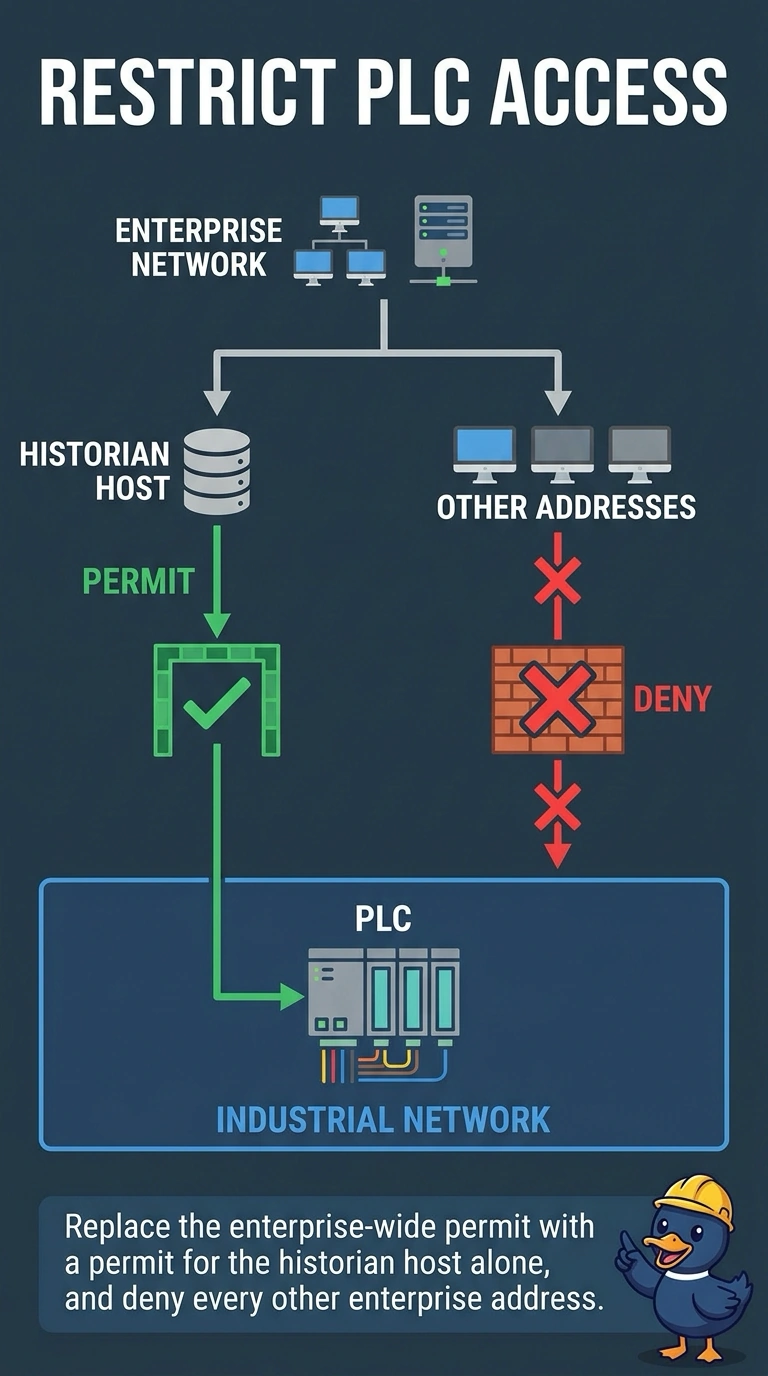
The design lets one trusted clerk through the gate, but the live rule lets the whole company through. You can match the design by permitting only the historian to query the batch PLCs and denying other enterprise addresses. A VLAN number or a MAC limit on the historian does not narrow that enterprise-wide allow.
Full Explanation
Segmentation at the OT/IT boundary depends on both the VLAN split and the filter that specifies who may cross. The intended source is the historian host, so replace the permit for the entire enterprise subnet with a permit for the historian alone and deny every other enterprise address. Permitting the whole subnet lets every business address attempt the PLC query, even though an ACL is present. Leaving that wide permit because the cell VLAN number exists confuses a broadcast domain with an access policy: once traffic is routed, the ACL controls which enterprise sources can reach the PLCs, and the VLAN number does not narrow a permit for the whole subnet. Moving the batch PLCs into the enterprise VLAN removes the boundary rather than tightening it. Port security limits MAC addresses on a switch port; enabling it on the historian does not change the IP ACL or prevent other enterprise hosts from matching its wide permit. Exam caveat: after narrowing the source, keep the destination and industrial ports narrow too, since a single-host permit for every IP protocol can still exceed the historian’s actual query needs. Practical check: verify that a query from the historian succeeds, a query from a second enterprise host is denied, and show ip access-lists displays the expected hits.