
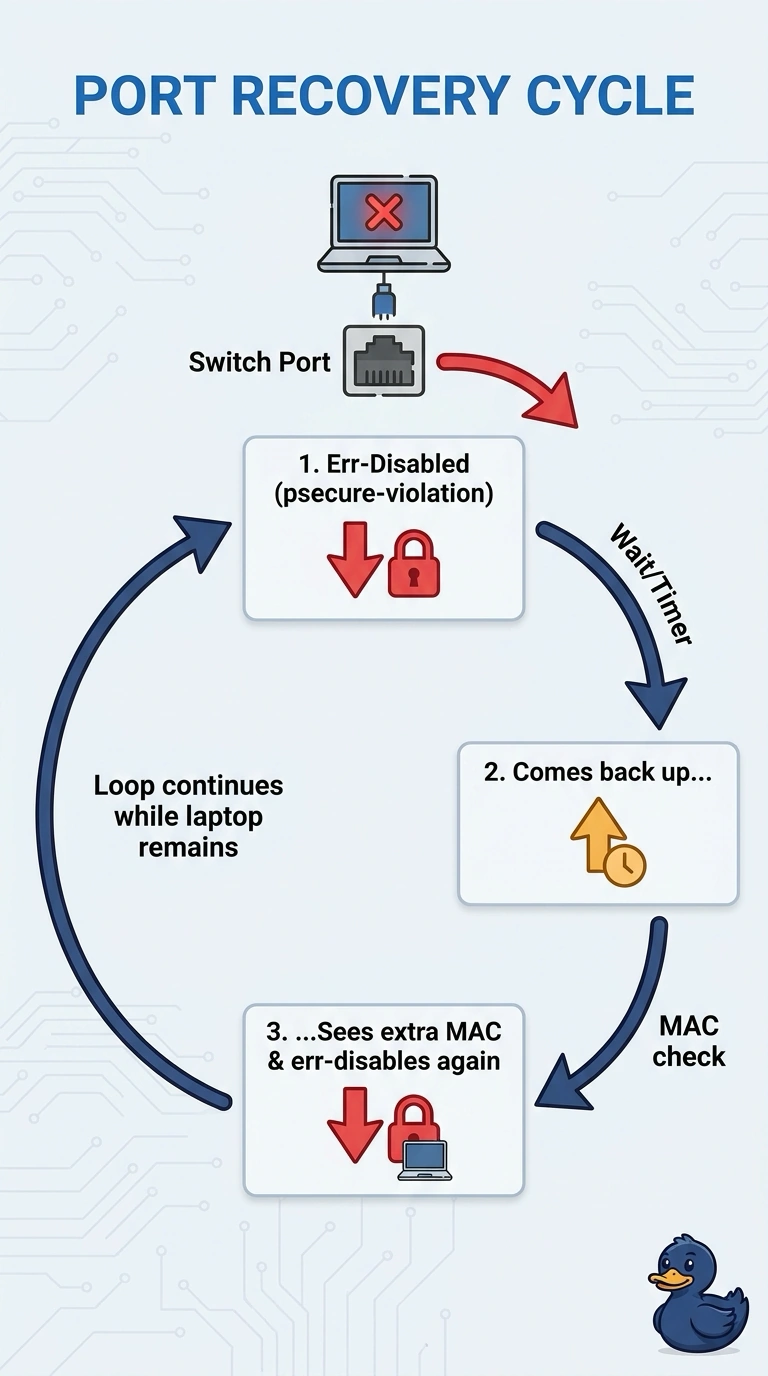
A crane PLC port on a Cisco Industrial Ethernet switch err-disabled after a laptop shared the jack. Recovery for psecure-violation is on, and the laptop is still plugged in. What does the port do when the timer expires?
Select an answer to reveal the explanation.
Short Explanation
Automatic recovery is a door that opens itself on a timer. If the laptop is still in the jack, you have not removed the reason the door shut, and the switch will shut it again. Recovery is not a pardon that rewrites the secure MAC list.
Full Explanation
On Cisco IOS, errdisable recovery for psecure-violation re-enables an interface that port security shut down, after the recovery interval. It does not change the violation mode, delete the secure MAC, or forget that a second MAC is a violation. When the crane port comes back and the laptop is still attached beside the PLC, the switch sees the extra source MAC, counts another violation, and err-disables the port again. The PLC drops with it. That cycle continues until someone removes the laptop. Returning in restrict mode and adopting the laptop would be a different configuration, not what recovery does. Recovery also does not clear port security or open the port to every MAC. The feature exists so a port can be tried again. It is not a wipe of the policy. Claiming recovery never applies to a security violation is the opposite of enabling it for psecure-violation. Exam caveat: many plants leave this recovery off on controller ports so a violation stays visible until a person looks. If you enable it, the timer is not a substitute for pulling the unexpected cable. Operational check: with the laptop removed, clear the err-disable or wait out a test timer in a window, confirm the PLC MAC is the only secure address, and confirm a second test MAC shuts the port again.