
A designer wants a firewall between a filling-line PLC and its remote input-output rack so every cyclic exchange is inspected. Which placement decision fits?
Select an answer to reveal the explanation.
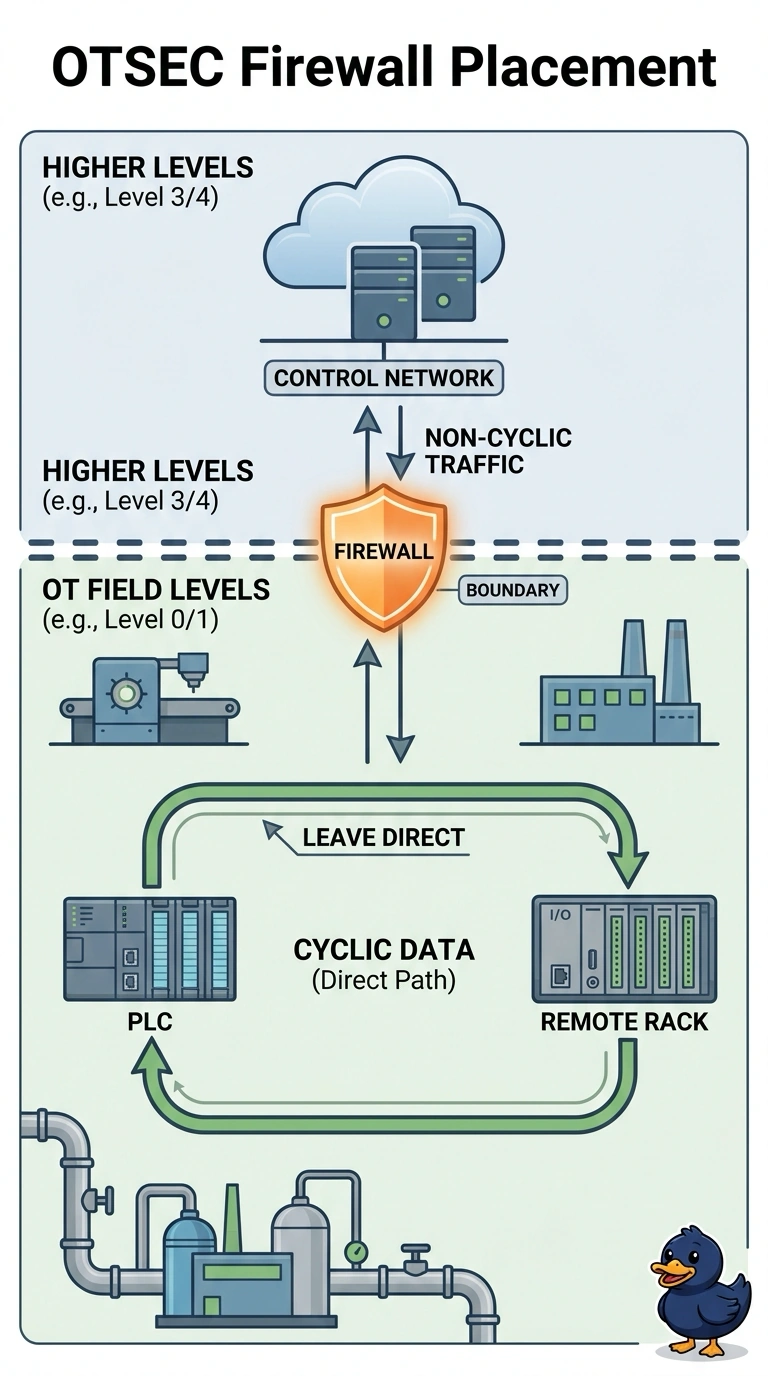
Short Explanation
You keep inspection at the planned zone boundaries, since a diode can't complete two-way I/O and a copy can't block. Avoid inserting an unvalidated firewall into this timing-critical I/O path. Validate latency, availability, protocol support and safety requirements before adding an inline security device; enforce the planned zone boundaries.
Full Explanation
Cyclic input-output between a PLC and its remote rack is part of the control loop. It is repetitive and time-sensitive, with commands toward the rack and status back toward the PLC on every cycle. Avoid inserting an unvalidated firewall into this timing-critical I/O path. Validate latency, availability, protocol support and safety requirements before adding an inline security device; enforce the planned zone boundaries. Here the planned boundary is between levels, so leaving that cyclic path direct preserves the loop while inspection and enforcement apply to traffic that actually crosses zones. Same-level microsegmentation can be valid in other conduits, such as between two cells, and that firewall stays on the path between the cells rather than inside a single controller's rack loop. Inserting the firewall into the loop and holding each packet for a full application signature adds delay and a failure point inside the process. A stall there stalls the filling line. Replacing the rack path with a data diode enforces one direction in hardware. Remote input-output needs two-way exchange, so a one-way device cannot complete that exchange and removes the process connection rather than inspecting it. Relying on a SPAN session copies frames to a monitor. The copy does not sit in the forwarding path and does not block unwanted traffic, so treating SPAN as a firewall confuses visibility with enforcement.